

Interventional Pain Management for Neck Pain Portland Patients Choose to Treat the Source, Not Just Mask It
- Home
- Interventional Pain Management for Neck Pain Portland Patients Choose to Treat the Source, Not Just Mask It
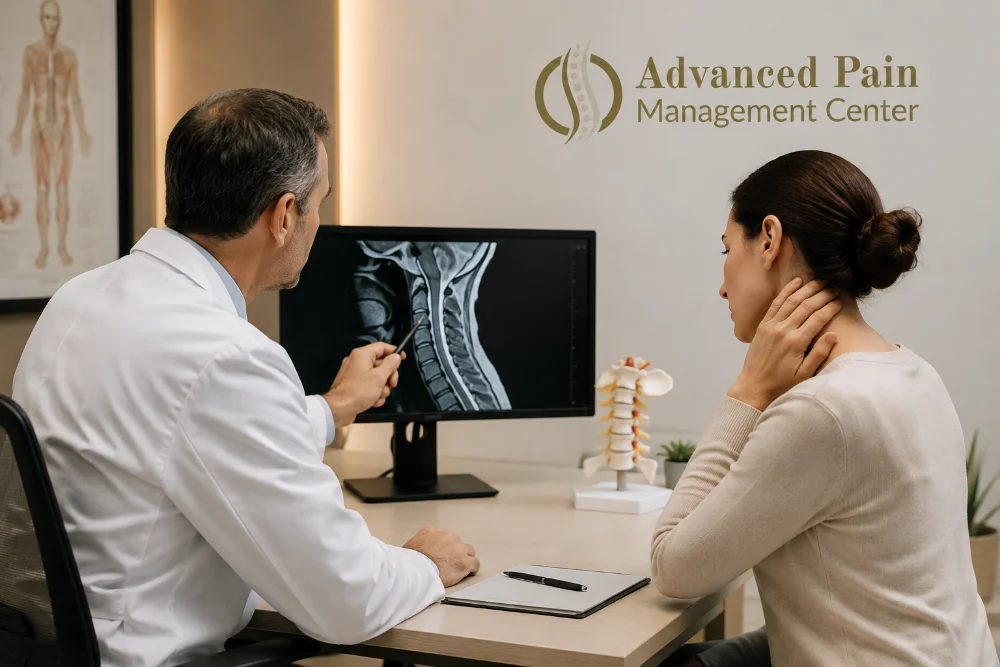
Living with chronic neck pain in Portland often means quietly editing your day around it, dreading long hours hunched over a downtown desk, bracing before a drive across the Hawthorne Bridge, or turning your whole body instead of your head to check a blind spot. Advanced Pain Management Center takes a different starting point. Rather than masking symptoms, the team at 10305 SW Park Way, Suite 300, in Portland’s West Haven area determines whether an interventional procedure is appropriate and, if so, which option best fits the diagnosis. Under interventional pain physician Vladimir Fiks, MD, the practice offers image-guided options for neck pain that include cervical epidural steroid injections, cervical medial branch blocks, and cervical radiofrequency ablation.
Schedule Your Portland Neck Pain Evaluation | Call (503) 295-0730
Finding the SW Park Way Office From Downtown Portland and the East Side
The office is located at 10305 SW Park Way, Suite 300, in the West Haven area of southwest Portland near Providence St. Vincent Medical Center. Patients visit from Downtown Portland, the Pearl District, the Rose Quarter, South Waterfront, and other parts of the metro area using routes that may include US-26 and I-405. Travel time varies according to the patient’s starting point, traffic, and appointment time. Patients can contact the office for current parking, entrance, and accessibility guidance.
The west-side location also serves patients from Beaverton, Tigard, Hillsboro, Lake Oswego, Aloha, the greater Portland area, and Southwest Washington. Depending on the starting point, patients may use US-26, Highway 217, or other regional routes. Weekday office hours provide several options for planning an evaluation or follow-up appointment.
The Portland Practice Built Around Evaluating What May Be Causing Your Neck Pain
Many people living with chronic neck pain have already tried treatments that eased their symptoms for a while without clarifying why the pain kept coming back. Advanced Pain Management Center was built around a different approach. Since opening in Portland in 2000, the practice has focused on interventional pain medicine, combining a careful clinical evaluation with image-guided procedures chosen according to the structure or nerve that may be generating the pain. Because neck pain is a symptom rather than one diagnosis, the plan considers whether an irritated cervical nerve root, an arthritic facet joint, or another cervical condition may be involved.
Neck pain can affect Portland residents in different ways. Long hours at a screen may aggravate discomfort for someone working in the Pearl District or downtown, while other people may be dealing with lingering stiffness after a collision, pain or tingling that travels into the shoulder or arm, or headaches that seem to begin at the base of the skull. Because each pattern may point to a different contributing condition, the evaluation considers symptoms, examination findings, imaging, and previous treatment before any procedure is recommended.
Why Portland Patients May Consider Advanced Pain Management Center for Neck Pain
Patients comparing neck pain treatment options in Portland may consider the practice’s source-focused evaluation, range of interventional options, and approach to individualized care. In their reviews, patients describe a team that keeps working with them to find appropriate options for persistent pain.
- A diagnosis-first approach: the team evaluates the likely source of neck pain before recommending a procedure, because the appropriate treatment depends on the diagnosis and the clinical findings
- Physician-performed spine procedures: Vladimir Fiks, MD, performs the practice’s interventional cervical spine procedures, with physician assistants and nursing staff supporting candidate selection and recovery
- Cervical injections, blocks, and ablation under one roof: cervical epidural steroid injections, cervical medial branch blocks, and cervical radiofrequency ablation are all offered at the Portland office
- Diagnostic blocks before ablation: a cervical medial branch block is generally used before radiofrequency ablation to assess whether facet-mediated pain is likely and whether ablation may be appropriate
- Image-guided procedures: fluoroscopic guidance is used to help place the needle at the intended spinal level or target nerve in the neck
- Attention to the headache connection: because pain from the upper cervical facet joints can contribute to cervicogenic headaches, the evaluation considers whether treating the neck may also help those headaches
- Regenexx-trained interventional physician: Dr. Fiks is a Regenexx physician with experience in image-guided interventional orthopedic care
- A middle ground between conservative care and surgery: for selected patients, interventional procedures may help reduce reliance on daily medication and support function, though candidacy always depends on the individual
- Coordinated whole-person care: the team refers patients to trusted outside partners for physical therapy and behavioral support when those services would help
- Multilingual physician care: Dr. Fiks speaks English, Spanish, and Russian
- Serving Portland since 2000: the practice has focused on pain diagnosis and treatment in the West Haven medical corridor for more than two decades
“I have been going to advanced pain management center for 27 years and they have always taken good care of my pain management.”
What Interventional Neck Pain Care Aims to Achieve for Portland Patients
Interventional care is organized around functional goals rather than a promise to cure. The goals below describe what these procedures may help selected patients work toward, always depending on the diagnosis and the individual.
Relief From Radiating Arm Pain, Numbness, and Tingling
When neck pain travels into the shoulder, arm, or hand because a cervical nerve root is inflamed, a cervical epidural steroid injection may reduce that inflammation and ease the radiating symptoms for a period of time. It does not repair a disc or open a narrowed canal, and relief is usually temporary, but for selected patients it may quiet nerve-related symptoms enough to move and rehabilitate more comfortably. Whether it fits depends on how well the symptoms and imaging line up.
Calmer, More Manageable Axial Neck Pain
For pain that stays centered in the neck and is suspected to involve the facet joints, cervical radiofrequency ablation may interrupt pain signals from selected medial branch nerves that serve those joints. Relief varies from person to person and is not permanent, because the treated nerve can regenerate over time, so this is best understood as longer-lasting relief for well-selected patients rather than a one-time fix. A diagnostic medial branch block is generally used first to assess whether facet-mediated pain is likely.
Support for Cervicogenic Headaches
Some headaches are linked to the upper cervical facet joints rather than to the head itself. When the evaluation suggests this pattern, addressing the cervical facets through the medial branch block and radiofrequency ablation pathway may help reduce the associated headaches in selected patients. This is framed as support that depends on an accurate diagnosis, not a guaranteed headache cure.
A Path That May Help Delay or Avoid Neck Surgery
Many patients arrive worried that neck surgery is the only option left. For carefully selected patients, interventional procedures may reduce reliance on daily pain medication and help delay or avoid a larger operation, though this is never a certainty and some conditions still require surgical evaluation. The aim is steady, measurable improvement in pain and function, reassessed after each step rather than assumed.
“These folks are always pleasant and professional. My questions are always answered promptly and thoroughly. Other pain management companies have treated me something like a drug seeker-which I am not. In fact I can not imagine anyone choosing to be tethered to mandatory monthly appointments, waiting for pharmacies to fill prescriptions, never being able to plan to go away for more than one month at a time fearing I may run out of medication. All just so I can try to act “normal” when pain tries to designate my every move. Thank you APMC!”
The Interventional Neck Pain Treatments Offered at the Portland Office
These options are not interchangeable, and none of them is right for every kind of neck pain. The team matches the procedure to the suspected source using the evaluation pathway below, then explains what each one can and cannot do.
Cervical Epidural Steroid Injections for Radiating, Nerve-Related Neck Pain
A cervical epidural steroid injection places anti-inflammatory medication into or near the epidural space around irritated cervical nerve roots, using image guidance. It is most relevant when neck pain radiates into the shoulder, arm, or hand from an inflamed nerve root, as with a disc herniation, degenerative disc disease, arthritis, or narrowing, and when the clinical pattern and imaging agree. The injection may reduce inflammation and provide temporary relief of radiating symptoms in selected patients, but it does not repair a disc or open a narrowed canal. Corticosteroids are not FDA-approved for epidural administration, and FDA labeling warns of rare but serious neurologic events after epidural corticosteroid injections. Dr. Fiks reviews the potential benefits, risks, and alternatives before treatment.
Cervical Medial Branch Blocks for Diagnosing Facet-Joint Neck Pain
A cervical medial branch block places local anesthetic near the small medial branch nerves that carry sensory signals from the facet joints. It is used mainly to test whether a specific facet joint is contributing to the neck pain. A meaningful temporary response after the block can help the provider decide whether cervical radiofrequency ablation may be appropriate. The block is primarily diagnostic, and one block does not automatically lead to ablation, since clinical criteria and coverage requirements can vary.
Cervical Radiofrequency Ablation for Facet-Mediated Neck Pain
Cervical radiofrequency ablation uses radiofrequency-generated heat delivered through a needle electrode to reduce the ability of selected medial branch nerves to transmit pain signals. It may be considered for chronic, predominantly axial neck pain suspected to arise from the facet joints, and sometimes for related cervicogenic headache, rather than for radicular arm pain. A diagnostic medial branch block is generally performed first. When it helps, relief may last for months and sometimes longer, but it is temporary because the treated nerve can regenerate. The procedure reduces pain signaling rather than repairing arthritis.
Diagnostic Evaluation and Matching the Right Procedure
Before any procedure, the team reviews your symptoms, history, and prior treatment, performs a physical and neurologic examination, and looks at X-ray, MRI, or CT imaging when it is clinically useful. Diagnostic injections, such as a cervical medial branch block, may be used to help assess whether a particular joint, nerve, or spinal level is contributing to the pain. New loss of bladder or bowel control, worsening arm or leg weakness, fever, or neck pain after a major injury are warning signs that call for urgent medical evaluation rather than a routine appointment. Each procedure has different risks, benefits, and alternatives, which Dr. Fiks reviews before care.
Neck Pain Services and Procedures Available at the Portland Office
- Comprehensive cervical spine and neck pain evaluation with physical, neurologic, and imaging review
- Cervical epidural steroid injections, including transforaminal selective nerve root block approaches
- Cervical facet joint injections
- Cervical medial branch blocks for diagnosing facet-mediated neck pain
- Cervical radiofrequency ablation for facet-mediated neck pain and related cervicogenic headache
- Fluoroscopic X-ray image guidance for cervical spine injections and radiofrequency procedures
- Diagnostic injections to help identify the joint, nerve, or level contributing to pain
- Spinal cord stimulation for appropriate chronic neck and arm pain when other treatments have not helped enough
- Regenexx regenerative options for selected cervical spine conditions
- Peripheral or muscular nerve entrapment care when symptoms come from outside the cervical spine
- Coordination with trusted outside partners for physical therapy and behavioral support
The Portland Providers Who Diagnose and Treat Neck Pain at the Practice
Every neck pain plan at the practice is guided by the licensed providers below, whom patients often describe as professional, thorough, and genuinely invested in finding solutions.
Vladimir Fiks, MD | Interventional Pain Management Physician and Regenexx Provider
Vladimir Fiks, MD, is the interventional pain physician who leads neck and spine pain care at Advanced Pain Management Center and performs the practice’s cervical interventional procedures. He graduated from Saratov University, completed an internship at Jefferson Frankford Hospital in Philadelphia, and then finished both an anesthesiology residency and a pain management fellowship at Oregon Health & Science University in Portland. As a Regenexx physician, he focuses on image-guided, interventional orthopedic care and practices both medical and interventional pain therapies through an integrative approach. Dr. Fiks speaks English, Spanish, and Russian, and he continues to expand his medical education so that patients benefit from his thoroughness.
“I have been seeing Dr. Fiks for at least 14 years now. I lived 1 1/2 hours away and now live 4 hours away. I could go to another Doctor closer to me, but I choose to stay with Dr. Fiks because of the care I receive from him and his staff. I receive injections on several occasions in my neck and back, they are trying very hard to help me manage my pain I endure on a daily basis. I highly recommend Advance Pain Management center to any one looking for relief of their pain. They have gone to great lengths for me, Thank You Dr. Fiks.”
Dmitriy Shore, PA-C | Interventional Pain Medicine Provider
Alberto Rodriguez, PA-C, MS | Interventional Pain Medicine Provider
Alberto Rodriguez, PA-C, MS, earned a Master of Science degree and completed his Physician Assistant studies at Pacific University in 2008, after undergraduate work at Central Washington University. He has provided patient-centered care across orthopedics, urgent care, family medicine, and pain management, a background that helps him evaluate complex conditions and build individualized plans. He helps identify appropriate candidates for interventional neck pain care and supports patients through recovery. He believes exceptional care begins with listening, and he takes time to educate each patient and partner with them in decisions about their treatment.
Quick Answers for Portland Patients Considering Neck Pain Care
Is Advanced Pain Management Center actually located in Portland?
Yes. The office is at 10305 SW Park Way, Suite 300, in the West Haven area of southwest Portland near Providence St. Vincent Medical Center. Interventional neck pain care and cervical procedures are provided at that Portland location.
Can the practice help with neck pain that started after a car accident?
Yes. Advanced Pain Management Center evaluates neck pain and whiplash associated with auto accidents. The assessment considers the injury history, symptoms, examination findings, previous care, and imaging when clinically appropriate before treatment is recommended.
Will I be put under general anesthesia for cervical injections or ablation?
The anesthesia or sedation plan depends on the specific procedure, your needs, and the clinical circumstances. Cervical injections are generally performed with local anesthesia, and the care team explains the plan for each procedure before treatment.
Portland Neighborhoods and Nearby Communities the Practice Serves
Nearby Portland neighborhoods and surrounding communities served by the SW Park Way office include:
- Portland, OR 97225, including the West Haven and Cedar Mill areas
- Downtown Portland and the financial district
- Pearl District and Northwest Portland
- South Waterfront
- Goose Hollow and the Providence Park area
- Multnomah Village and Raleigh Hills
- Rose Quarter, Lloyd District, and the Central Eastside
- Sylvan and the US-26 corridor
- Southwest Portland near Providence St. Vincent Medical Center
- The greater Portland area and Southwest Washington
- Beaverton
- Tigard
- Hillsboro
- Lake Oswego
- Aloha
How Neck Pain Care Fits Into a Portland Week
Portland runs on movement, from morning rides across the river bridges to long weekday hours at downtown desks and weekend recreation whenever the rain lets up. Chronic neck pain quietly chips away at all of it, turning a commute across the Hawthorne Bridge or a simple shoulder check into something to think twice about. The practice is located in Portland’s West Haven area and offers weekday appointments for evaluations, procedures, and follow-up care. Patients can contact the office to discuss scheduling and visit logistics before symptoms become more limiting.
Set Up a Neck Pain Evaluation in Portland
Call (503) 295-0730 or schedule online to start a consultation conversation with the Advanced Pain Management Center team. The front desk can explain what to bring and discuss appointment logistics. If your neck pain began after an injury or accident, let them know so the relevant history is available for the visit.
- Address: 10305 SW Park Way, Suite 300, Portland, OR 97225
- Website: https://apmconline.org/
- Hours: Monday to Friday: 8:00 AM to 5:00 PM. Saturday: Closed. Sunday: Closed
Call (503) 295-0730 | Schedule Your Portland Neck Pain Evaluation
Advanced Pain Management Center 10305 SW Park Way, Suite 300, Portland, OR 97225
Frequently Asked Questions About Interventional Pain Management for Neck Pain Portland
How can I tell if my neck pain is serious?
Many episodes of neck pain are not medical emergencies, but certain signs warrant prompt evaluation, including pain that follows a significant injury, comes with fever, or brings new numbness, weakness, or loss of bladder or bowel control. Pain that steadily worsens, disturbs sleep, or does not improve over several weeks is also worth having checked.
What are the top 5 reasons for neck pain?
Common contributors include muscle strain from posture and long screen time, cervical disc problems such as herniation or degeneration, facet-joint arthritis, nerve-root irritation, and injuries such as whiplash. Because neck pain is a symptom rather than one diagnosis, an evaluation looks at which of these may be involved.
What are the four types of neck pain?
There is no single universally accepted four-type classification for neck pain. Clinically, neck pain may be described by patterns such as axial pain felt mainly in the neck, radicular pain that travels into the shoulder or arm, cervicogenic headache linked to the upper neck, or pain associated with an injury such as whiplash. The pattern helps guide the evaluation and which treatment options may be appropriate.
What happens if you don't treat neck pain?
Some neck pain eases on its own, but pain that is left unaddressed can sometimes become persistent and harder to manage, and it may limit sleep, work, and daily movement. When neck pain is ongoing or comes with nerve symptoms, an evaluation helps identify what may be contributing before it becomes more limiting.
Can stress cause neck pain?
Stress can contribute to neck pain by increasing muscle tension and by making existing pain feel more intense. It is rarely the whole story, so stress-related tension is best considered alongside a proper evaluation of the cervical spine rather than in place of one.
Can an epidural injection be used to treat neck pain?
Yes, a cervical epidural steroid injection may be considered when an irritated cervical nerve root is causing radiating arm pain, numbness, or tingling. The procedure is image-guided and is recommended only after a provider reviews the diagnosis, imaging, medical history, and risks.
Can facet joint injections be done in the neck?
Yes. Cervical facet joint injections and medial branch blocks target the small joints and their nerve supply in the neck. They may be used to help diagnose whether a facet joint is contributing to the pain and, in some cases, to help manage it.
What conditions does a cervical medial branch block treat?
A cervical medial branch block is used mainly as a diagnostic test for suspected facet-mediated neck pain, including pain from arthritis or whiplash and sometimes cervicogenic headache. A meaningful temporary response can help the provider decide whether cervical radiofrequency ablation may be appropriate.
How successful is radiofrequency ablation for neck pain?
Results vary by patient and diagnosis. Current guidance supports benefit in well-selected patients, particularly when a diagnostic medial branch block indicates facet-mediated pain. Relief is not guaranteed, and it is best viewed as longer-lasting rather than permanent because the treated nerve can regenerate.
How long does it take to recover from cervical neck ablation?
Recovery after cervical radiofrequency ablation varies by patient and procedure. Temporary soreness, swelling, or bruising can occur, and activity guidance depends on the treatment and individual response. Dr. Fiks provides procedure-specific aftercare instructions and explains when to resume normal activities and when to contact the office about unexpected symptoms.
What is the best treatment for chronic neck pain?
There is no single treatment that is right for everyone. The appropriate option depends on the diagnosis, symptoms, imaging, and prior care. Many patients start with conservative measures, and when pain persists, image-guided options such as cervical injections, medial branch blocks, or radiofrequency ablation may be considered based on the suspected source.
How long does neck pain usually last?
Many episodes of neck pain improve within a few days to a few weeks, but some become chronic, generally meaning pain lasting more than three months. Pain that lingers, keeps returning, or comes with nerve symptoms is worth having evaluated rather than waiting it out.
What kind of doctor should I see for neck pain?
An interventional pain management physician evaluates possible sources of neck pain and provides image-guided, minimally invasive treatments when appropriate, and may coordinate with physical therapy or surgical specialists. At Advanced Pain Management Center, Dr. Fiks provides cervical interventional procedures according to the patient’s diagnosis and needs.
What are the risks or side effects of cervical radiofrequency ablation?
Reported effects can include temporary discomfort, swelling, or bruising, and there is a small risk of infection or bleeding. Ablation intentionally changes the function of the targeted nerve, the nerve can regenerate over time, and it is not appropriate for every neck-pain pattern. A provider reviews the specific risks and alternatives before treatment.
How long does a cervical epidural steroid injection last for neck pain?
Relief varies widely and is generally temporary, sometimes lasting from several weeks to a few months, and some patients respond better than others. Local anesthetic can produce short-term early relief, while the anti-inflammatory steroid effect may take longer to develop. Repeat injections are guided by the response and documented benefit rather than a fixed schedule.
Neck Pain Health Resources From Advanced Pain Management Center
To learn more about neck pain and the ways it can be evaluated and treated, explore the related procedures and articles below from Advanced Pain Management Center in Portland, OR.
Neck pain services and procedures
Articles from the APMC pain management blog
- 3 Injections That Can Help Relieve Chronic Neck Pain
- The Link Between Neck Problems and Arm Numbness
- Will I Feel Immediate Relief After a Spine Injection?
- When Is Radiofrequency Ablation the Best Choice for Pain Management?
Meet the physician
Neck Pain Care in Portland That Starts With a Focused Evaluation
If you are tired of planning life around neck pain, Advanced Pain Management Center will take the time to evaluate what may be contributing to the symptoms, explain which options may fit in plain language, and focus on both day-to-day comfort and how well you move through a full week. Contact the Portland team when you are ready to schedule an evaluation.
Take the First Step Toward Neck Pain Relief in Portland
Schedule Your Portland Neck Pain Evaluation | Call (503) 295-0730
Advanced Pain Management Center 10305 SW Park Way, Suite 300, Portland, OR 97225
Hours:
- Monday to Friday: 8:00 AM to 5:00 PM
- Saturday: Closed
- Sunday: Closed