
Interventional Pain Management Serving Aloha, OR With Regenexx, Spinal Decompression, and Neuropathy Care
- Home
- Interventional Pain Management Serving Aloha, OR With Regenexx, Spinal Decompression, and Neuropathy Care
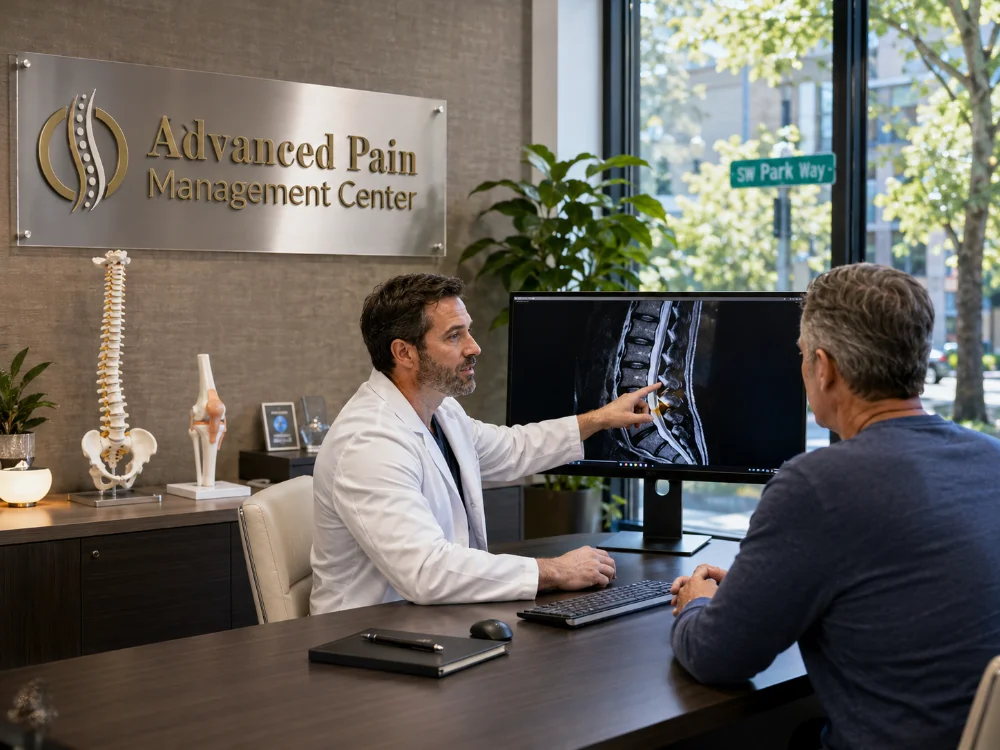
Aloha sits just west of Portland along the Tualatin Valley Highway and 185th Avenue corridor, close enough that residents can reach specialized spine, joint, and nerve care in the SW Park Way medical district without a long trip into the city center. Advanced Pain Management Center treats patients at 10305 SW Park Way, Suite 300 in Portland, inside the medical corridor beside Providence St. Vincent Medical Center and a short drive from Aloha by way of US-26 and Highway 217. Care is led by Vladimir Fiks, MD, an interventional pain management physician and Regenexx provider, alongside Dmitriy Shore, PA-C and Alberto Rodriguez, PA-C, with a focus on Regenexx regenerative treatment, spinal decompression for spinal stenosis, peripheral neuropathy care, and image-guided procedures rather than long-term reliance on pain medication.
Where Aloha Patients Turn for Spine, Nerve, and Regenerative Pain Care Before Considering Surgery
Many people carrying chronic back, neck, joint, or nerve pain have already cycled through primary care visits, short-term prescriptions, and advice to simply wait and see. Advanced Pain Management Center was built for the next step, when a patient wants a clear diagnosis of what is actually generating the pain and a treatment plan aimed at the source instead of another round of medication. The practice pairs interventional procedures with regenerative options through Regenexx, so Aloha patients can weigh non-surgical and minimally invasive routes before agreeing to a larger operation.
The patients who make the drive from Aloha tend to fall into a few groups. Some are dealing with spinal stenosis, sciatica, or degenerative back pain and want to understand whether spinal decompression or targeted injections can relieve the pressure. Others have joint or tendon damage from an old injury, arthritis, or an active lifestyle and are curious whether Regenexx regenerative treatment can help them delay or avoid orthopedic surgery. A third group lives with peripheral neuropathy and the burning, numbness, or tingling that comes with it. Each one starts with the same thorough evaluation and a plan matched to the specific condition rather than a single default treatment.
Getting From Aloha to the SW Park Way Office Without Heading Into Downtown Portland
There is no Advanced Pain Management Center location inside Aloha itself. All care is delivered at 10305 SW Park Way, Suite 300, in the West Haven area of Portland, tucked into the medical corridor next to Providence St. Vincent Medical Center. For most Aloha addresses, the trip is a straightforward run east on US-26, the Sunset Highway, with a short connection onto Highway 217, and it usually takes about fifteen to twenty minutes depending on the time of day. Patients never have to fight through downtown Portland to get there.
That location is part of what makes the office practical for Westside patients. People coming from the Tualatin Valley Highway and 185th Avenue side of Aloha, the neighborhoods around Mountain View Champions Park, or the quieter streets near the Jenkins Estate and Cooper Mountain can fold an appointment into the same trip as errands closer to Beaverton or the Sunset Corridor. Because the office sits in an established medical pocket rather than a congested city block, parking and building access stay simple, which matters when a patient is already dealing with spine or nerve pain and does not want a stressful arrival.
Why Aloha Patients Bring Their Spine, Joint, and Nerve Pain to APMC
Aloha patients generally arrive after comparing their options and deciding they want a practice focused on finding and treating the cause of pain, not just managing symptoms. The points below cover what they tend to name as the deciding factors.
- Interventional focus beyond medication management: the practice centers on image-guided procedures and regenerative options designed to address specific pain generators rather than relying primarily on long-term medication management.
- Regenexx regenerative treatment on site: Dr. Fiks is a Regenexx provider offering bone marrow concentrate and platelet-based procedures that may help patients delay or avoid orthopedic surgery
- Spine and stenosis expertise: spinal decompression, spinal injections, radiofrequency ablation, and vertebrogenic pain procedures address back and leg pain from stenosis, sciatica, and degenerative discs
- Dedicated peripheral neuropathy care: Dr. Fiks has advanced training in treating the burning, numbness, and tingling that come with nerve damage, with options that go beyond generic pain medication
- Fellowship-trained providers: Dr. Fiks completed a pain management fellowship at Oregon Health and Science University, and the team brings decades of combined interventional experience
- Minimally invasive options first: many procedures, such as the mild® decompression approach, make liberal use of numbing medication and light sedation given by IV or orally, keeping patients comfortable and often supporting a quick return to normal activity
- Whole-patient recovery approach: treatment plans consider a patient’s overall recovery and function, with cognitive behavioral support available as part of the plan, since recovery often involves more than a single procedure
- Multilingual, welcoming team: the staff speaks English, Spanish, and Russian, and has kept a warm, inclusive environment since the practice opened in 2000
- Westside-friendly location: the SW Park Way office beside Providence St. Vincent is a short US-26 and Highway 217 drive from Aloha, with easy parking and no downtown congestion
The Long-Term Results Aloha Patients Aim For With Interventional Care
Relief From Chronic Back and Spine Pain Without Rushing Into Surgery
Restored Joint and Orthopedic Function Through Regenexx
Relief From Nerve Pain and Better Peripheral Neuropathy Management
A Return to Daily Activity and Independence
Types of Pain and Spine Care Aloha Patients Can Access at APMC
Regenexx Regenerative Treatment
Spinal Decompression and Spine Pain Procedures
Peripheral Neuropathy and Nerve Stimulation
Interventional Injections and Infusion Therapies
The interventional menu covers a wide range of injection therapies, including joint injections, trigger point injections, peripheral nerve blocks, and image-guided epidural and facet procedures. It also includes ketamine infusion therapy for treatment-resistant chronic pain, spinal infusion pump therapy that delivers medication directly to the spinal fluid, and MLS laser therapy to support healing. Auto accident injury evaluation and cognitive assessments round out the services available to Aloha patients.
APMC Services Available to Patients Traveling In From Aloha
- Regenexx regenerative treatment, a non-surgical option for orthopedic conditions
- Regenexx-SD bone marrow concentrate procedure selected joint, spine, and tendon conditions
- Platelet-rich plasma and platelet lysate procedures for soft tissue and joint injuries
- Spinal decompression, including the minimally invasive mild® procedure for spinal stenosis
- Tubular foraminotomy to open the space around a compressed nerve root
- Facet fusion to stabilize a painful or unstable spinal segment
- Spinal injections for cervical, thoracic, and lumbar pain
- Radiofrequency ablation for potentially longer-lasting relief from facet and nerve pain
- Vertebrogenic pain treatment with basivertebral nerve ablation, the Intracept procedure
- Kyphoplasty for spinal fractures and weakened vertebrae
- Minimally invasive spinal fusion to stabilize the spine and relieve nerve pressure
- SI joint fusion for sacroiliac joint instability and related low back pain
- Peripheral neuropathy treatment for burning, numbness, and tingling
- Peripheral nerve stimulation to interrupt pain signals from a specific nerve
- Spinal cord stimulation for chronic pain that has not responded to other care
- Spinal infusion pump therapy for direct, low-dose pain medication delivery
- Injection therapies, including joint, trigger point, and peripheral nerve block injections
- Ketamine infusion therapy for treatment-resistant chronic pain
- MLS laser therapy that may help reduce pain and support recovery
- Spine pain treatment combining injections, decompression, stimulation, and regenerative options
- Auto accident injury evaluation and treatment
- Cognitive assessments as part of a whole-patient care plan
The Pain Management Team Aloha Patients See at APMC
Every appointment is delivered by one of the licensed providers below, each focused on diagnosing and treating the source of pain.
Vladimir Fiks, MD, Interventional Pain Management Physician and Regenexx Provider
Dr. Fiks is a Regenexx physician and the founding force behind Advanced Pain Management Center, part of a selective network of interventional orthopedics providers focused on musculoskeletal conditions and image-guided treatments. He graduated from Saratov University in Russia, completed an internship at Jefferson Frankford Hospital in Philadelphia, and finished both his anesthesiology residency and his pain management fellowship at Oregon Health and Science University in Portland. Using an integrative approach, he practices both medical and interventional pain therapies and looks beyond a single procedure to a patient’s overall recovery. He believes physical and mental wellness are part of recovery, and he speaks English, Spanish, and Russian.
Alberto Rodriguez, PA-C, Pain Management Provider
Alberto Rodriguez is a physician assistant who has cared for patients across orthopedics, urgent care, family medicine, and pain management over the past 18 years. He completed his physician assistant training and a Master of Science at Pacific University in Forest Grove, Oregon, in 2008, after earning his bachelor’s degree at Central Washington University and taking part in a University of Washington clinical program along the way. That range of experience helps him sort through complex spine, joint, and nerve complaints and build a treatment plan around what each patient wants to get back to. Alberto sees listening as the starting point of good care, taking the time to explain each condition and its options so Aloha patients can make informed decisions. A dedicated weightlifter himself, he stays current with the latest medical literature and brings an evidence-based mindset to every visit.
Dmitriy Shore, PA-C, Pain Management Provider
Dmitriy Shore is a physician assistant who has been nationally board certified by the National Commission on Certification of Physician Assistants since graduating from Oregon Health and Science University in 2000. He has devoted his career to treating chronic pain conditions and is known for a compassionate, patient-focused style. A naturally curious clinician, he actively pursues continuing education and reviews the latest pain management literature so his care reflects current practice. Aloha patients working with him can expect thorough attention to their history and goals.
Before You Drive In From Aloha: Three Quick Answers
Is there an Advanced Pain Management Center office located in Aloha?
No. All care is delivered at 10305 SW Park Way, Suite 300 in Portland, beside Providence St. Vincent Medical Center. Aloha patients travel a short distance east to reach the office, and the team is glad to help plan an appointment time that works around your day.
How long does the drive from Aloha to the Portland office usually take?
For most Aloha addresses the trip runs about fifteen to twenty minutes, taking US-26, the Sunset Highway, over to Highway 217, with no need to drive into downtown Portland. The front desk can suggest windows that avoid the heaviest commute times.
Can Aloha patients use telehealth instead of coming in for every visit?
Yes. Advanced Pain Management Center offers telehealth, which can be a practical option for certain follow-up visits and consultations. In-person visits are still needed for imaging, procedures, and hands-on evaluation, and the team will let you know which appointments require a trip in.
Westside Communities Around Aloha That APMC Welcomes Patients From
Patients reach the SW Park Way office from across Aloha and the wider Washington County Westside. Common origin points for visits include:
- Aloha, OR (97003, 97006, 97007, 97078)
- Tualatin Valley Highway and 185th Avenue corridor
- Mountain View Champions Park area
- Jenkins Estate and Cooper Mountain neighborhoods
- South Aloha and the Cooper Mountain foothills
- Reedville and the central Aloha residential area
- Beaverton
- Hillsboro
- Bethany
- Cedar Mill
- West Haven and the SW Park Way medical corridor
- Sunset Corridor along US-26
- Raleigh Hills and Garden Home
- The wider Washington County Westside
Fitting Spine, Joint, and Nerve Care Into Everyday Life in Aloha
What Patients Say After Being Treated at APMC
“I just finished my first visit at Advanced Pain and I am so very impressed! From the front desk, to the nurses administering tests, to meeting with the doctor and then leaving the office, everything was different. This was the most caring and thoughtful medical experience I have ever had, and I have had 14 surgeries in the past 5 years so I know.”
“The nurses are friendly, competent, and knowledgeable. Dr. Fiks was kind and compassionate. I didn’t spend much time with him because I was under IV anesthesia. Thank you for your dedicated work!”
“Excellent care. As a patient advocate, I have a pretty strong personality and didn’t want to turn anyone off. What I found was exceptional support. Very kind and brilliant physicians and a great staff. It’s an honor to be a patient here. The staff is incredible and both Dr. Fiks and Dr. Shmidt get me.”
Ready to Address the Pain? Reach the APMC Team From Aloha
Call (503) 295-0730 or schedule online to start a consultation conversation with the Advanced Pain Management Center team. The front desk will walk you through what a first evaluation looks like, what imaging or records to bring, and how to time the short drive in from Aloha so it fits around your day.
• Address: 10305 SW Park Way, Suite 300, Portland, OR 97225
• Website: https://apmconline.org/
• Hours: Monday to Friday, 8:00 AM to 5:00 PM. Closed Saturday and Sunday.
Call (503) 295-0730 | Start Your Aloha Consultation
Advanced Pain Management Center 10305 SW Park Way, Suite 300, Portland, OR 97225
Common Questions About Interventional Pain Management Serving Aloha, OR
Is a Regenexx procedure painful?
Most patients tolerate it well. The injections are placed with ultrasound or fluoroscopic guidance and feel similar to a typical shot at a doctor’s office, and the treatment area is numbed beforehand. Temporary soreness at the injection site may occur for a day or two.
Does Regenexx actually work?
Regenexx tracks patient outcomes in a registry and publishes that data, and many patients report meaningful reductions in pain and improved function. Like any medical procedure, it has a success and failure rate and no result can be guaranteed, so candidacy is evaluated individually based on your imaging and condition.
What conditions can Regenexx treat?
Regenexx procedures are used for orthopedic and musculoskeletal problems, including osteoarthritis, joint injuries, spine pain, tendon and ligament damage, overuse conditions, and common sports injuries. During your evaluation, Dr. Fiks reviews whether your specific condition is a good fit for a regenerative approach.
How long do Regenexx results last?
Many patients begin noticing improvement over the first one to three months, with continued gains for several months as the body heals. How long relief lasts depends on the condition treated, its severity, and your activity level, and some patients choose a follow-up treatment over time.
Can Regenexx repair a torn rotator cuff?
Regenexx procedures may help certain partial rotator cuff and tendon tears by supporting the body’s natural repair process. Whether it is appropriate depends on the size and type of tear, which is assessed with imaging during your consultation. Larger complete tears may still require surgical repair.
How is spinal decompression at APMC different from a chiropractic decompression table?
The spinal decompression offered here is a medical procedure rather than repeated pulls on a traction table. For spinal stenosis, the minimally invasive mild® approach removes excess ligament tissue to restore space in the spinal canal, and other cases may call for injections or surgical decompression. Dr. Fiks determines the right approach from your imaging rather than a set schedule of sessions.
How long does recovery from spinal decompression take?
With the minimally invasive mild® procedure, there are typically no implants, stitches, or general anesthesia, and many patients resume normal activity within about 24 hours. Recovery from open surgical decompression takes longer, and your provider will explain the expected timeline for your specific procedure.
What are the most common causes of peripheral neuropathy?
Diabetes is the most common cause, followed by physical injury or trauma to a nerve and a range of systemic factors such as autoimmune conditions, certain medications or chemotherapy, alcohol use, and vitamin deficiencies. Identifying the underlying cause is a key part of building an effective treatment plan.
How can peripheral neuropathy be kept from getting worse?
The most reliable step is addressing the underlying cause, such as controlling blood sugar for diabetic neuropathy, alongside targeted treatment of the symptoms. Early evaluation matters, because catching nerve changes sooner gives the best chance of protecting function. Dr. Fiks has advanced training in managing the varied symptoms of neuropathy.
Is interventional pain management the same as being prescribed pain pills?
No, and this is an important distinction. Interventional pain management uses image-guided procedures, regenerative treatments, and targeted therapies to treat the source of the pain, rather than relying on long-term painkiller prescriptions. The goal is to improve function and provide longer-term symptom relief rather than simply masking symptoms.
Can spinal stenosis be treated without major surgery?
In many cases, yes. Spinal stenosis is the narrowing of the spinal canal that puts pressure on the nerves, and options such as the minimally invasive mild® decompression procedure, spinal injections, and other interventional treatments are designed to relieve that pressure without open surgery. The right choice depends on your imaging and symptoms.
Do Aloha patients have to go into downtown Portland to get Regenexx here?
No. Regenexx procedures for Aloha patients are performed at the SW Park Way office in the West Haven medical corridor beside Providence St. Vincent Medical Center, reached by US-26 and Highway 217 without driving into the city center. Many patients from Aloha choose the office specifically because it avoids downtown traffic.
Does APMC treat peripheral neuropathy for patients from Aloha and the rest of Washington County?
Yes. The practice regularly sees neuropathy patients traveling from Aloha, Beaverton, Hillsboro, Bethany, and Cedar Mill across Washington County. Neuropathy treatment for Aloha patients starts with identifying the cause of the nerve damage, then building a plan that may include targeted therapy and, when needed, nerve stimulation.
Can Aloha residents get non-surgical back pain and sciatica treatment at the office?
Yes. Back pain treatment for Aloha patients often begins with non-surgical and minimally invasive options such as spinal decompression, spinal injections, and radiofrequency ablation, chosen based on imaging of the spine. Sciatica and stenosis-related leg pain are common reasons Westside patients come in, and surgery is considered only when it is truly needed.
Is parking easy at the SW Park Way office for patients driving in from Aloha?
Yes. The office sits in an established medical corridor beside Providence St. Vincent rather than a congested downtown block, so parking and building access stay simple. The front desk can share entry and parking details when you confirm your visit.
Which Aloha and Westside neighborhoods do most patients travel from?
Patients commonly come from central Aloha along the Tualatin Valley Highway and 185th Avenue, the areas near Mountain View Champions Park, and the quieter neighborhoods around the Jenkins Estate and Cooper Mountain, along with nearby Beaverton, Hillsboro, Bethany, and Cedar Mill. The SW Park Way office is a short, familiar Westside drive for all of them.
Real Relief for Aloha Patients Who Want More Than Masked Symptoms
If you are ready for a practice that takes the time to understand where your pain is really coming from, one that will explain your spine, joint, nerve, and regenerative options in plain language and build a plan aimed at both easing the pain and restoring how you move, Advanced Pain Management Center is ready to help. Reach out whenever you are ready, and the team will help you plan the short trip in from Aloha.
Begin Your Path Out of Chronic Pain Today
Start Your Aloha Consultation | Call (503) 295-0730
Advanced Pain Management Center 10305 SW Park Way, Suite 300, Portland, OR 97225
Hours:
• Monday to Friday: 8:00 AM to 5:00 PM
• Saturday: Closed
• Sunday: Closed