
Spinal Decompression in Portland, OR: Minimally Invasive Care for Lumbar Stenosis and Disc Herniation
- Home
- Pain Management Services in Portland, OR
- Spinal Decompression in Portland, OR: Minimally Invasive Care for Lumbar Stenosis and Disc Herniation
Last Updated: September 9, 2026
For Portland adults whose lumbar stenosis or disc herniation has not improved with medication or physical therapy, the question is often whether open back surgery is the only option. For some patients, a minimally invasive decompression procedure may offer another path. Advanced Pain Management Center provides spinal decompression at 10305 SW Park Way, Suite 300, in Portland’s West Haven area near Providence St. Vincent Medical Center. Vladimir Fiks, MD, an interventional pain management physician and Regenexx provider, personally performs every decompression procedure, with support from Alberto Rodriguez, PA-C, MS, and Dmitriy Shore, PA-C, who help identify appropriate candidates and guide postoperative care. The procedures offered here are minimally invasive and outpatient, with the specific approach matched to the patient’s symptoms, imaging findings, previous treatment, and spinal stability.
Schedule Your Portland Spine Evaluation | Call (503) 295-0730

What Spinal Decompression Does and Where It Fits in Spine Care
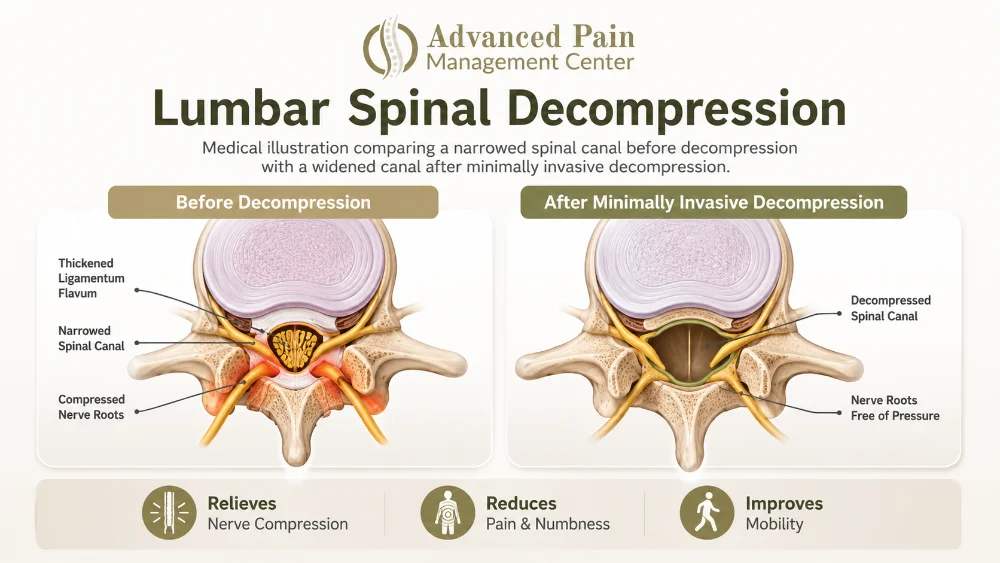
Spinal decompression refers to procedures that create more room around compressed spinal nerves. At APMC, it is used most often for symptomatic lumbar spinal stenosis that has not improved with conservative care and for selected chronic or acute disc herniations that press on a nerve. Some patients may have minimally invasive options between medication, physical therapy, injections, and traditional open surgery. Dr. Fiks evaluates the structural problem and recommends the least aggressive option that fits the patient’s symptoms, imaging findings, previous treatment, and spinal stability.
Patients who come in for decompression often share a similar story. Some have watched their walking distance shrink and now plan every outing around where they can sit. Others feel sharp or radiating pain traveling down one leg from a herniated disc. Many have already tried physical therapy, medication, or injections and want to know what comes next without immediately committing to a larger operation. When symptoms and imaging point to spinal instability in addition to compression, decompression may be combined with a stabilization procedure. Every path starts with a review of the symptoms, examination findings, and imaging before a procedure is recommended.
The spinal decompression offered at APMC is not mechanical traction or table-based “non-surgical spinal decompression” sometimes offered in chiropractic settings. APMC provides minimally invasive interventional procedures that directly address specific sources of lumbar nerve compression, including thickened ligament, foraminal narrowing, and herniated disc material. When spinal instability is also present, a minimally invasive stabilization or fusion procedure may be considered.
Reaching the SW Park Way Spine Clinic From Around Portland
The clinic is located at 10305 SW Park Way, Suite 300, in the West Haven area near Providence St. Vincent Medical Center. Patients travel to the office from Cedar Mill, Sylvan, Raleigh Hills, Hillsdale, and other west-side communities using routes such as US-26 and Highway 217. Travel time depends on the starting point, traffic, and appointment time. Patients can contact the office for current parking, entrance, and accessibility guidance.
Access matters when back or leg pain makes driving and walking difficult. Sunset Transit Center provides MAX and bus connections on Portland’s west side, although patients may need a connecting bus, rideshare, or other transportation to reach the clinic. The office is located in a private outpatient setting separate from the nearby hospital campus. Patients can contact the front desk for current parking, entrance, accessibility, and public-transit guidance.
Patients seeking a minimally invasive lumbar decompression evaluation also travel from Beaverton, Tigard, Hillsboro, Aloha, Lake Oswego, and other west-side communities.
Reasons Portland Patients Choose APMC for Spinal Decompression
Patients weighing a decompression procedure usually want more than a quick yes or no. They want to understand which technique fits their spine, what recovery looks like, and whether they can avoid a larger operation. That care shows up in the practice’s standing on Google, where one Portland patient, Veronique Nelson, wrote, “The staff at Advanced Pain Management Center makes you feel as if you were family. They support you and make the process much easier to handle. They are kind and compassionate.” The reasons below are the ones decompression patients tend to point to most.
- One physician performing every procedure: Dr. Fiks personally performs all decompression procedures at APMC, providing continuity between procedure planning and treatment. Alberto Rodriguez, PA-C, MS, and Dmitriy Shore, PA-C, support candidate evaluation and postoperative care
- A range of minimally invasive techniques: APMC offers the mild® Procedure, ELID decompression for foraminal, interlaminar, and disc-related compression, and interspinous or facet-joint stabilization when spinal instability is present. The recommended technique is selected according to the patient’s symptoms, imaging findings, anatomy, and spinal stability
- Minimally invasive and outpatient by design: APMC reports that its decompression procedures generally take approximately 40 to 60 minutes, depending on complexity, and are performed under local anesthesia with IV sedation. Patients are typically discharged after approximately one hour of outpatient recovery when clinically appropriate
- Care that escalates only as far as it needs to: treatment starts with the conservative steps most likely to help and moves toward decompression only when symptoms keep progressing, or relief runs out
- Insurance and Medicare verification: Coverage varies by procedure, medical necessity, and individual plan requirements. APMC verifies applicable Medicare or insurance benefits, coverage requirements, and potential patient responsibility before scheduling.
- Evaluation focused on the structural problem: symptoms, examination findings, and imaging are reviewed to evaluate whether stenosis, disc herniation, or spinal instability may be contributing to the symptoms. Diagnostic injections may be considered when a particular nerve, level, or overlapping pain source needs further clarification
- Support throughout the treatment process: Alberto Rodriguez, PA-C, MS, and Dmitriy Shore, PA-C, help identify appropriate candidates and support postoperative care alongside Dr. Fiks and qualified nursing staff
- Support beyond the procedure: when physical therapy or behavioral health support may be helpful, APMC refers patients to trusted outside healthcare partners
- An established Portland practice: Dr. Fiks founded Advanced Pain Management Center in 2000, providing continuity within an established Portland pain management practice
- Multilingual care and west-side access: Dr. Fiks speaks English, Spanish, and Russian. Patients can contact the office for current parking, entrance, accessibility, and public-transit guidance

How Dr. Fiks Decides Whether Decompression Is the Right Step
Decompression is considered when the evaluation indicates that a structural problem may be contributing to the symptoms and the findings fit a condition the procedure can address. Dr. Fiks works through the four steps below before recommending treatment.
Reviewing the Symptoms and How They Behave
The evaluation begins with a close look at where the pain, heaviness, numbness, or cramping occurs and how the symptoms change throughout the day. Dr. Fiks also reviews the patient’s medical history and how long the patient can comfortably stand or walk. Lumbar stenosis often follows a recognizable pattern, with symptoms worsening while standing or walking and improving while sitting, bending, or leaning forward. A herniated disc may cause sharp or radiating pain in one leg. These patterns help guide the evaluation but are considered together with the examination and imaging.
A Physical and Neurological Examination
A hands-on examination checks muscle strength, reflexes, sensation, posture, walking pattern, balance, and coordination. These findings may show signs of nerve involvement and help determine how the symptoms are affecting strength, mobility, and daily function. The examination also helps identify symptoms that may require more urgent evaluation or a different treatment approach.
Imaging to Locate the Problem
When appropriate, MRI, CT, or X-ray imaging may help identify spinal narrowing, thickened ligament, disc changes, alignment problems, instability, and areas where nerves may be compressed. The images are reviewed alongside the patient’s symptoms and examination findings rather than used on their own. When the findings indicate spinal instability, a stabilization procedure may be considered with or instead of decompression alone.
Diagnostic Injections to Help Clarify the Pain Source
In some cases, a diagnostic spinal injection may help determine whether a particular nerve root, spinal level, facet joint, or another structure is contributing to the symptoms. Dr. Fiks considers the response alongside the patient’s history, examination, and imaging when deciding whether decompression or another treatment is appropriate.
Diagnostic Evaluation and Matching the Right Treatment
Before any procedure, the team reviews the patient’s symptoms, medical history, and previous treatment, performs a physical and neurologic examination, and reviews X-ray, MRI, or CT imaging when clinically useful. Diagnostic injections, such as a medial branch block, may also help assess whether a particular joint, nerve, or spinal level is contributing to the pain.
Treatment selection considers not only the suspected pain source but also what the treatment is intended to accomplish. Depending on the diagnosis, the goal may be to reduce inflammation, interrupt or modify pain signaling, relieve nerve compression, stabilize an unstable joint or spinal segment, support rehabilitation of dysfunctional muscles, or palliate persistent pain that has not responded adequately to more definitive treatment.
Additional options at the practice may include kyphoplasty for painful compression fractures, basivertebral nerve ablation for vertebrogenic pain, and Regenexx regenerative care for selected spine conditions.
New loss of bladder or bowel control, saddle numbness, rapidly worsening leg weakness, back pain with fever, or pain after a major injury are warning signs that call for urgent medical evaluation rather than a routine appointment.
Each procedure has different risks, benefits, limitations, and alternatives. Possible complications vary according to the treatment and may include temporary soreness, bleeding, infection, medication or sedation reactions, nerve injury, or lack of benefit. Dr. Fiks reviews procedure-specific considerations and postoperative instructions before care.

The Decompression Options Dr. Fiks May Recommend
APMC offers several minimally invasive approaches for lumbar spinal stenosis, disc herniation, and nerve compression. Depending on what is causing the narrowing, treatment may involve removing tissue that is compressing a nerve or using interlaminar distraction to increase space within the spinal canal and neural foramina. When spinal instability is also present, Dr. Fiks may incorporate stabilization through interlaminar fusion or facet fusion. The recommended approach depends on the patient’s symptoms, examination findings, imaging, anatomy, and spinal stability.
Conservative Care Before Any Procedure
Decompression is generally considered after more conservative steps have not provided enough relief. Earlier treatment may include activity modification, exercise, physical therapy through a trusted referral partner, over-the-counter or prescription medication, and spinal injections such as epidural steroid injections. These treatments may reduce symptoms and help the care team understand how the condition responds before a decompression procedure is considered.
The mild® Procedure for Direct Decompression
The mild® Procedure is a minimally invasive lumbar decompression option for selected patients with lumbar spinal stenosis and neurogenic claudication when hypertrophy, or thickening, of the ligamentum flavum contributes to narrowing of the spinal canal. Through a small access point, Dr. Fiks removes small portions of the thickened ligament to create additional space within the canal. It may be considered after medication, physical therapy, or other conservative treatment has not provided enough relief. The procedure is performed on an outpatient basis under local anesthesia with IV sedation and does not require a large open incision. APMC can verify the patient’s individual Medicare coverage before scheduling.
Targeted ELID Decompression for Nerve Compression and Disc Herniation
For compression involving a specific nerve root, spinal level, or herniated disc, Dr. Fiks may perform ELID decompression tailored to the imaging and examination findings. This can include foraminal decompression, known as ELID EX, to open the channel where a nerve exits the spine; interlaminar decompression to reduce pressure within the spinal canal; or ELID DX discectomy to remove disc material pressing on a nerve. Each procedure is minimally invasive and outpatient, with the approach selected according to the location and type of compression.
Interlaminar Distraction and Fusion When Spinal Stenosis Includes Instability
Spinal stenosis can sometimes occur alongside instability at the affected spinal segment. In selected patients, Dr. Fiks may use minimally invasive interlaminar distraction and fusion to increase space within the spinal canal and neural foramina while stabilizing the affected level. APMC uses devices including StabLink and InSpan for this purpose.
This approach is not necessary for every patient with spinal stenosis. The decision to add stabilization depends on the location and severity of the narrowing, the presence of instability, the patient’s symptoms and examination findings, and the overall spinal anatomy seen on imaging.
Diagnostic Evaluation and Matching the Right Treatment
Before any procedure, the team reviews the patient’s symptoms, medical history, and previous treatment, performs a physical and neurologic examination, and reviews X-ray, MRI, or CT imaging when clinically useful. Diagnostic injections, such as a medial branch block, may also help assess whether a particular joint, nerve, or spinal level is contributing to the pain.
Treatment selection considers not only the suspected pain source but also what the treatment is intended to accomplish. Depending on the diagnosis, the goal may be to reduce inflammation, interrupt or modify pain signaling, relieve nerve compression, stabilize an unstable joint or spinal segment, support rehabilitation of dysfunctional muscles, or palliate persistent pain that has not responded adequately to more definitive treatment.
Additional options at the practice may include kyphoplasty for painful compression fractures, basivertebral nerve ablation for vertebrogenic pain, and Regenexx regenerative care for selected spine conditions.
New loss of bladder or bowel control, saddle numbness, rapidly worsening leg weakness, back pain with fever, or pain after a major injury are warning signs that call for urgent medical evaluation rather than a routine appointment.
Each procedure has different risks, benefits, limitations, and alternatives. Possible complications vary according to the treatment and may include temporary soreness, bleeding, infection, medication or sedation reactions, nerve injury, or lack of benefit. Dr. Fiks reviews procedure-specific considerations and postoperative instructions before care.
Facet Fusion for Spinal Instability
When spinal stenosis is accompanied by instability, facet fusion may be considered as another minimally invasive stabilization option. The procedure is intended to stabilize the affected spinal segment by promoting fusion across the facet joint. Whether facet fusion is appropriate depends on the source and degree of instability, the level involved, imaging findings, symptoms, and the patient’s overall treatment needs.
Facet fusion is not required for spinal stenosis itself. It is considered when instability is also contributing to the patient’s condition and stabilization is clinically appropriate.
Spine and Decompression Services Available at the SW Park Way Clinic
- Comprehensive spine evaluation to assess lumbar stenosis, disc herniation, nerve compression, or spinal instability
- MRI, CT, and X-ray review to evaluate the location and severity of the spinal problem
- Diagnostic spinal injections to help evaluate suspected or overlapping pain sources
- The mild® Procedure for minimally invasive direct decompression
- ELID EX foraminal decompression for selected nerve-root compression
- ELID interlaminar decompression to relieve pressure within the canal
- ELID DX discectomy for selected symptomatic disc herniations
- Epidural steroid injections for stenosis- or disc-related nerve and leg pain
- Facet joint injections and medial branch blocks for overlapping facet pain
- Spinal cord stimulation for persistent nerve pain when other options have not helped
- Fluoroscopy- and ultrasound-guided procedures performed on-site when appropriate
- Postoperative care and analgesia managed by Dr. Fiks, the PA-C team, and qualified nursing staff
- Physical therapy and behavioral health support through trusted outside referral partners
- Interlaminar distraction and fusion using StabLink or InSpan for selected patients with spinal stenosis and instability
- Minimally invasive facet fusion when stabilization of an unstable spinal segment is clinically appropriate
The Team Behind Spinal Decompression at APMC
Dr. Fiks personally performs every decompression procedure at APMC. Alberto Rodriguez, PA-C, MS, and Dmitriy Shore, PA-C, support candidate evaluation, treatment planning, and postoperative care under Dr. Fiks’s direction, alongside qualified nursing staff. One Portland patient, Malon Metz, wrote, “The entire staff starting with the front desk through to my procedure to being released was so kind, considerate, and concerned for my well being. I would recommend them to everyone.”
Vladimir Fiks, MD (Interventional Pain Management Physician and Regenexx Provider)
Dr. Vladimir Fiks founded Advanced Pain Management Center in 2000 and has built the practice around evaluating the structural and functional contributors to spine pain and providing individualized interventional care. He graduated from Saratov University in Russia, completed an internship at Jefferson Frankford Hospital in Philadelphia, and completed his anesthesiology residency and pain management fellowship at Oregon Health & Science University in Portland. Dr. Fiks personally performs APMC’s decompression procedures, including the mild® Procedure, targeted ELID decompression, discectomy, and stabilization procedures when spinal instability is present. He favors minimally invasive techniques that prioritize patient comfort, safety, mobility, and spinal stability. He is also a Regenexx provider and speaks English, Spanish, and Russian.
Alberto Rodriguez, PA-C, MS (Pain Management Provider)
Alberto Rodriguez, PA-C, MS, brings experience across orthopedics, urgent care, family medicine, and pain management. He helps evaluate patients who may be candidates for decompression and supports their care before and after treatment. He earned his bachelor’s degree at Central Washington University and completed his physician assistant training and Master of Science at Pacific University in Forest Grove, Oregon, in 2008. His approach emphasizes listening, patient education, and shared treatment decisions.
Dmitriy Shore, PA-C (Pain Management Provider)
Dmitriy Shore, PA-C, is board-certified by the National Commission on Certification of Physician Assistants and graduated from Oregon Health & Science University in 2000. He has extensive experience supporting patients with chronic pain and helps evaluate candidates for decompression and manage postoperative needs alongside Dr. Fiks and the nursing team. He continues his education in pain management and uses a compassionate, patient-focused approach.
Quick Questions Portland Patients Ask Before a Decompression Visit
Which decompression procedures does Dr. Fiks perform at the Portland clinic?
Dr. Fiks performs the mild® Procedure for direct decompression, targeted ELID decompression for a compressed nerve or herniated disc, including foraminal decompression and discectomy, and interlaminar distraction and fusion for selected patients with spinal stenosis and instability. All are minimally invasive and outpatient. The appropriate option depends on the patient’s symptoms, examination findings, imaging, anatomy, and spinal stability.
Is decompression here mainly for the lower back or also the neck?
APMC’s decompression procedures focus on the lower back, where lumbar stenosis and disc herniations are most common. Neck-related symptoms are evaluated as part of a broader spine assessment, and the team will tell you if a different treatment path fits your situation better.
Can I bring MRI or CT images from another Portland provider to my evaluation?
Yes, and it helps. Bringing recent imaging and any prior spine records lets Dr. Fiks review the problem sooner and may reduce repeat testing. The front desk can tell you the easiest way to send images ahead of your visit.
Portland Neighborhoods and Westside Communities We See Decompression Patients From
Spine patients reach the SW Park Way clinic from across Portland and the surrounding Westside. Common areas we see patients from include:
- Portland, OR 97225 and surrounding ZIP codes
- West Haven and Sylvan
- Cedar Mill
- Raleigh Hills
- Garden Home and Hillsdale
- Multnomah Village
- Northwest and Southwest Portland
- The Forest Park and Sylvan-Highlands area
- Beaverton
- Tigard
- Hillsboro
- Aloha
- Lake Oswego
- Bethany
- The wider Washington County Westside
How Stenosis and Disc Pain Change a Portland Week, and How Decompression Aims to Give It Back
Lumbar stenosis and a herniated disc have a way of quietly rewriting a Portland week. The hike into Forest Park that used to clear your head becomes a calculation about how far you can go before symptoms force you to stop, a walk through Cedar Hills Crossing turns into a search for the next place to sit, and standing long enough to cook or wait in line starts to feel like a chore. Many patients adapt without noticing, leaning on carts, skipping the trail, and planning outings around benches until their world has quietly narrowed. Decompression care at APMC is intended to reduce pressure on affected nerves and help appropriate patients improve standing, walking, and daily function. Patients also describe the support they receive from the team. Google reviewer Melanie Andersen wrote that “Everyone I have dealt with has been very friendly and helpful. My questions have been answered and appointments and procedures have been made promptly.” Weekday hours from 8:00 AM to 5:00 PM leave room to plan an evaluation without upending the rest of the week.
Plan a Decompression Evaluation Without Rearranging Your Whole Day
Call (503) 295-0730 or schedule a spine evaluation online with the Advanced Pain Management Center team. The front desk can explain appointment logistics, which records or imaging to bring, and available scheduling or accessibility options. If standing or walking is difficult, mention this when booking so the team can discuss appropriate visit arrangements.
- Address: 10305 SW Park Way, Suite 300, Portland, OR 97225
- Website: https://apmconline.org/
- Hours: Monday to Friday, 8:00 AM to 5:00 PM. Closed Saturday and Sunday.
Call (503) 295-0730 | Schedule Your Portland Spine Evaluation
Advanced Pain Management Center 10305 SW Park Way, Suite 300, Portland, OR 97225
Frequently Asked Questions About Spinal Decompression in Portland, OR
How risky is spinal decompression?
Risks vary by procedure and may include infection, bleeding, lack of benefit, or neurological injury. The minimally invasive approach is designed to reduce tissue disruption, but it does not eliminate the possibility of complications. Procedures involving an implanted stabilization device or fusion may have additional considerations. Dr. Fiks reviews the specific risks, benefits, and alternatives before treatment.
Who should not have spinal decompression?
Decompression may not be the right fit when symptoms come from a source other than stenosis or a disc herniation, or when certain health conditions make a procedure unsafe. When the spine is unstable, a stabilization step may be needed along with or instead of decompression. The evaluation, imaging, and sometimes a diagnostic injection help sort this out before anything is recommended.
Does APMC offer non-surgical spinal decompression?
No. APMC does not provide mechanical or table-based non-surgical spinal decompression therapy. Dr. Fiks performs minimally invasive interventional procedures designed to directly address specific sources of lumbar nerve compression. These procedures use smaller access points than traditional open spine surgery but are still medical or surgical procedures. Nonsurgical treatments such as medication, referred physical therapy, and injections may be considered earlier in the treatment plan when appropriate.
Is spinal decompression a permanent fix?
Results and durability vary. Some patients may experience relief that lasts for an extended period, but spinal decompression cannot be guaranteed as a permanent fix. The spine may continue to change, and symptoms may return or develop at another level over time.
How do you know if the spine needs decompression?
Possible clues include stenosis symptoms that worsen with standing or walking and improve when sitting or leaning forward, or radiating leg pain associated with a herniated disc. Imaging may also show areas of nerve compression. Decompression is usually considered when those symptoms limit daily life and conservative care has not given enough relief. The examination and imaging help determine whether nerve compression from stenosis or a herniated disc is contributing to the symptoms.
How long does a spinal decompression take?
APMC reports that its decompression procedures generally take approximately 40 to 60 minutes, depending on complexity. They are performed on an outpatient basis under local anesthesia with IV sedation. Discharge timing depends on the procedure and recovery from sedation, although patients are typically discharged after approximately one hour when clinically appropriate.
What are the side effects of spinal decompression?
Temporary soreness may occur after a minimally invasive decompression procedure. Some patients may use prescribed postoperative pain medication for approximately three to five days. Other possible risks may include infection, bleeding, lack of benefit, or neurological injury. Dr. Fiks explains the procedure-specific risks and postoperative instructions before treatment.
How do you know if spinal decompression is working?
Possible signs of improvement may include easier standing or walking and reduced pain, heaviness, cramping, numbness, or tingling. The timing and degree of improvement vary. Tracking symptoms between visits helps the care team evaluate recovery and determine whether additional treatment is needed.
What conditions does spinal decompression treat?
At APMC, spinal decompression is used most often for symptomatic lumbar spinal stenosis and selected chronic or acute disc herniations that compress a nerve. It may help reduce back, buttock, or leg symptoms when nerve compression is contributing to pain, numbness, tingling, heaviness, cramping, or weakness. When spinal instability is also present, decompression may be combined with a stabilization procedure.
Is the mild® Procedure the same as open back surgery?
No. The mild® Procedure is performed through a small access point rather than a large open incision. It removes portions of thickened ligament contributing to spinal narrowing and is performed under local anesthesia with IV sedation. APMC reports that patients are generally discharged the same day after completing the required outpatient recovery period.
What is the difference between spinal decompression and spinal stabilization?
Spinal decompression is intended to create more room for compressed nerves by addressing the tissue or structural narrowing responsible for the pressure. Stabilization is used when abnormal movement or instability is also part of the problem. For selected patients with spinal stenosis and instability, Dr. Fiks may use minimally invasive interlaminar distraction and fusion with devices such as StabLink or InSpan, or consider facet fusion when appropriate. Not every patient who needs decompression also needs stabilization.
How long is recovery after minimally invasive spinal decompression?
Recovery varies by procedure and patient. APMC reports that patients are typically discharged the same day and may use prescribed postoperative pain medication for approximately three to five days. Dr. Fiks and the PA-C team provide individualized instructions for activity, medication, and follow-up.
Will I need spinal fusion along with decompression?
Not necessarily. Many patients undergoing decompression do not require fusion. Stabilization may be considered when the evaluation identifies clinically significant instability in addition to nerve compression or spinal stenosis. Depending on the anatomy and affected level, options may include minimally invasive interlaminar distraction and fusion or facet fusion. Dr. Fiks determines whether stabilization is appropriate based on symptoms, examination findings, imaging, and spinal stability.
Does spinal decompression help sciatica or leg pain from stenosis or a herniated disc?
It may help when sciatica or leg symptoms come from nerve compression caused by lumbar stenosis or a herniated disc. Reducing nerve pressure may improve radiating pain, heaviness, numbness, or tingling. The evaluation helps determine whether decompression is appropriate for the source of the symptoms.
Spine Health Resources on Decompression, Stenosis, and Recovery
The guides below come from the Advanced Pain Management Center team to help you understand spinal decompression, lumbar stenosis, disc herniation, and the options that may fit your spine. They are for general education and do not replace an in-person evaluation with a provider.
Understanding Spinal Decompression and Stenosis
Spine Care That Fits How Portland Patients Actually Move
For anyone tired of planning life around the next place to sit, APMC takes the time to evaluate what may be contributing to the pain, numbness, and reduced walking tolerance. The team explains conservative care, decompression, and stabilization options in plain language and builds a plan around the patient’s symptoms, imaging, spinal stability, and treatment goals. Contact the Portland office to schedule an evaluation.
Begin Your Portland Spine Evaluation
Schedule Your Portland Spine Evaluation | Call (503) 295-0730
Advanced Pain Management Center 10305 SW Park Way, Suite 300, Portland, OR 97225
Hours:
- Monday to Friday: 8:00 AM to 5:00 PM
- Saturday: Closed
- Sunday: Closed

Does it ache if you stand up straight? Do you find relief only when you flex your back? You might be one of up to 500,000 Americans who have spinal stenosis. This degenerative disease worsens the longer you leave it untreated. Advanced Pain Management Center in Portland, Oregon, has an experienced team led by interventional pain management physician Vladimir Fiks, MD. They practice both direct and indirect spinal decompression. Both of these techniques are minimally invasive treatments that are successful in treating spinal stenosis. Call the practice today to make an appointment or book through the website, also serving the surrounding areas of Aloha, Hillsboro, Beaverton, Tigard & Lake Oswego.
Spinal Decompression Q&A
What is direct spinal decompression?
Direct spinal decompression is accomplished by removing some of the tissues around the spine, which may include some of the surrounding bone and/or ligament to increase the capaciousness of the spinal canal. This can be accomplished by minimally invasive spinal decompression MILD or open surgical decompression.
MILD is an early treatment option to consider if more conservative therapies, such as physical therapy or pain medications, are not providing adequate relief. The mild® Procedure addresses a major root cause of LSS by removing excess ligament tissue to restore space in the spinal canal. The procedure typically takes less than an hour and requires no implants, stitches, general anesthesia, steroids, or opioids. Patients typically resume normal activity within 24 hours with no restrictions.
MILD is nationally covered by Medicare (all ages, all plan types) nationwide.
What is indirect spinal decompression?
Indirect spinal decompression treats lumbar spinal stenosis (LSS). Spinal stenosis is the abnormal narrowing or pinching of the spinal canal when you stand straight. It results in pressure on the spinal cord nerves, causing numbness and pain. Often, the only way someone with stenosis can find relief is by leaning forward or sitting.
What are common symptoms of lumbar spinal stenosis?
Lumbar spinal stenosis is often the result of wear and tear on the spine from everyday activities. It occurs when the spinal canal narrows, causing pain and discomfort in the legs and back. People with stenosis experience symptoms that include:
- Sciatica pain
- Loss of endurance
- Dull, aching pain around the legs, groin, and buttocks
- Numbness or tingling in the calves, thighs, and buttocks
- Loss of balance
- Back pain
- Neck pain
- Shoulder and neck range of motion problems
To treat lumbar spinal stenosis, Dr. Fiks uses the Superion® device in an innovative, minimally invasive procedure to relieve pressure on the affected nerves.
How does indirect spinal decompression work?
Dr. Fiks puts his patients’ comfort and safety at the forefront of all his treatments, which is why he favors the Superion indirect spinal decompression system. It works by holding the spinal vertebrae apart even when standing, which prevents pinching and relieves pressure on the nerves. Usually, you’d need to sit down or take a flexed position to achieve this, which is severely limiting.
Indirect spinal decompression is an effective next step for people who have had no success with conservative treatment but for whom traditional spinal surgery is too aggressive. It lasts for up to five years.
If you have any questions about your suitability for the procedure, Dr. Fiks can provide you with expert guidance.
What happens during indirect spinal decompression treatment?
Spinal decompression is a straightforward procedure that takes around 30 minutes, and you can go home just a few hours later. During surgery, Dr. Fiks makes a small incision in the lower back, and then he places the Superion device using a dime-sized tube. The bone and tissue remain intact, and there’s next to no blood loss. Because of the minimally invasive nature, recovery time is swift, and the spine remains stable.
Dr. Fiks welcomes patients who have received a diagnosis of lumbar spinal stenosis. He works with you to provide comprehensive pain management services. Call Advanced Pain Management Center today to make an appointment or book it over the phone.