
Numbness, Tingling, and Burning Nerve Pain: Peripheral Neuropathy Treatment in Portland, OR
- Home
- Pain Management Services in Portland, OR
- Numbness, Tingling, and Burning Nerve Pain: Peripheral Neuropathy Treatment in Portland, OR
Last updated August 13, 2026.
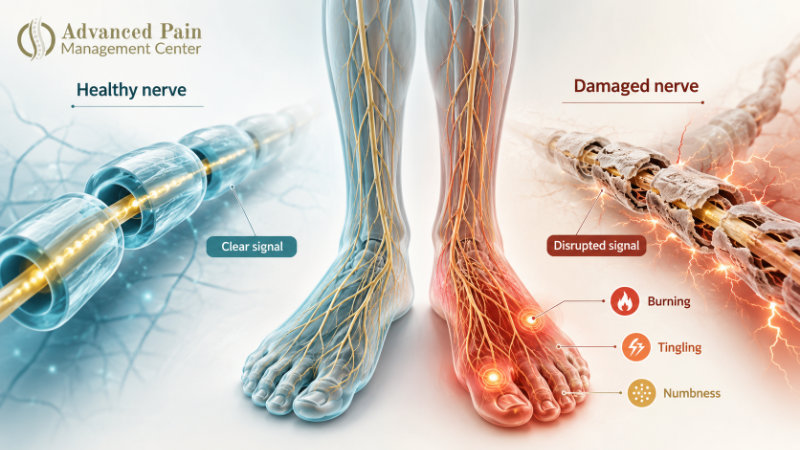
Burning, tingling, numbness, or a heavy, wooden feeling in the feet and hands can make walking, sleeping, and getting through an ordinary day harder than it should be, and depending on the cause, symptoms may worsen or spread over time. Advanced Pain Management Center treats peripheral neuropathy at 10305 SW Park Way, Suite 300 in Portland, in the West Haven medical corridor beside Providence St. Vincent Medical Center. Care is led by Vladimir Fiks, MD, an interventional pain management physician and Regenexx provider, alongside Alberto Rodriguez, PA-C and Dmitriy Shore, PA-C, who work to identify the nerves involved and build a plan aimed at reducing pain, supporting function, and protecting mobility where possible.
Request Your Portland Appointment | Call (503) 295-0730
What Peripheral Neuropathy Is and Why the Nerves Stop Sending Clear Signals
Peripheral neuropathy is the name for what happens when the peripheral nerves, the ones that run outside the brain and spinal cord to the skin, muscles, and organs, become damaged, compressed, or diseased. Those nerves normally carry steady signals for sensation, movement, and automatic functions, so when they misfire the result can be lost signals, false signals such as burning or tingling, or garbled messages that leave the feet and hands feeling numb or painfully oversensitive. Because the longest nerves are usually affected first, symptoms often begin in the toes and feet and work their way upward, which is why many people first notice the problem as unsteady balance or a change in how the floor feels underfoot.
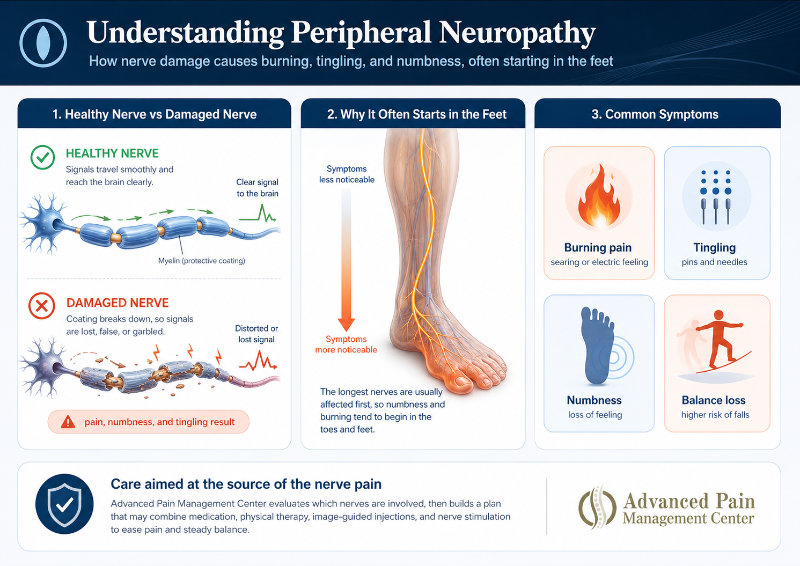
The people who come to the SW Park Way clinic for neuropathy tend to describe a familiar set of frustrations. Some have diabetes and have watched the numbness and burning in their feet slowly worsen, while others are dealing with nerve pain after chemotherapy, an injury, shingles, or a cause no one has pinned down yet. Many have already tried medication that either wore off or brought side effects they could not live with, and they want someone to find out which nerves are actually involved before deciding what comes next. What they share is a wish to understand the cause before committing to any long-term treatment, and that is where every plan at the clinic begins.
Finding the SW Park Way Neuropathy Clinic From Across Portland
For neuropathy patients, getting to an appointment should not be its own ordeal, and the SW Park Way location is set up with that in mind. The clinic is at 10305 SW Park Way, Suite 300, tucked into the West Haven medical district beside Providence St. Vincent Medical Center, with ground-level access and nearby parking available for patients. From most of Portland’s west side, including the Sylvan, Cedar Mill, Raleigh Hills, and Hillsdale neighborhoods, patients can reach the office by routes such as US-26 or Highway 217, with travel time depending on starting point, traffic, and appointment time.
That kind of access is not a small thing when balance is unsteady and the soles of the feet are numb or burning. The office is a private outpatient setting inside an established medical corridor rather than a sprawling hospital campus, so there is no long trek through connected towers to reach the suite. Patients across the Portland metro choose the SW Park Way office because it puts specialized nerve care close to home and can make follow-up visits easier to plan.
Portland also draws patients from the surrounding Westside, and many people looking for painful neuropathy treatment in Oregon travel in from Beaverton, Tigard, Hillsboro, Aloha, and Lake Oswego along the same highways, since the office sits at a natural crossing point for the metro area.
What Sets APMC Apart for Neuropathy Patients in Portland
Portland patients with neuropathy often want more than symptom control. They want to understand which nerves are involved, why symptoms may be progressing, and what options are available if medication is not enough. For anyone searching for a neuropathy specialist in Portland, OR, the differences below are the ones that tend to matter most.
Advanced training focused on nerve pain:
Dr. Fiks has specific training in evaluating and treating the varied symptoms of peripheral neuropathy, from burning feet to loss of balance
Care that escalates only as far as you need:
treatment starts with the least invasive approach likely to help and steps up to injections or neuromodulation only if the symptoms call for it
Neuromodulation options for selected candidates:
the practice performs both peripheral nerve stimulation and spinal cord stimulation, each with a trial period so you can assess whether it helps before any long-term device decision is made
Procedures targeted to the suspected pain source:
fluoroscopy and ultrasound help guide each injection or lead placement to the specific nerve or spinal level suspected of producing symptoms
A search for the cause, not a mask for the pain:
the goal is to find and address the source of the nerve trouble and protect your function, rather than leaning on long-term painkillers alone
A plan that treats more than the pain:
because nerve pain affects sleep, mood, movement, and balance at once, care may coordinate medical treatment, interventional options, outside rehabilitation support, and behavioral support when appropriate
Coverage many patients worry about:
peripheral nerve stimulation and spinal cord stimulation may be covered by Medicare or private plans for appropriate candidates, and the office can verify benefits before anything is scheduled
Care in the language you are most comfortable in:
the team cares for patients in English, Spanish, and Russian
A Portland practice with decades behind it:
Dr. Fiks opened Advanced Pain Management Center in 2000 and has led it ever since, giving patients long-term continuity with an established Portland pain management practice
An outpatient setting that is easy to reach:
the SW Park Way clinic beside Providence St. Vincent offers ground-level access and nearby parking, a real benefit when walking any distance is uncomfortable
Getting to the Source of Your Neuropathy Before Treatment Begins
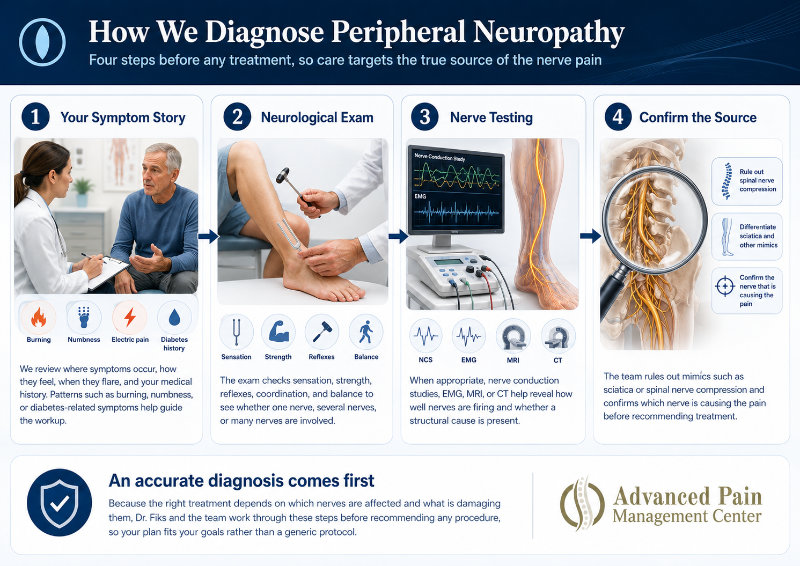
An accurate diagnosis is what helps move neuropathy care beyond trial and error, because the right treatment depends on which nerves are involved and what is damaging them. Dr. Fiks and the team work through the four steps below before recommending any procedure.
Listening to the Full Symptom Story
Every evaluation opens with a thorough conversation about where the symptoms are, how they feel, when they flare, and how they affect daily life, along with a review of your medical and family history. Patterns matter here, since burning that is worse at night, numbness that started in the toes, or symptoms tied to diabetes each point in a different direction. Understanding your goals early helps shape a plan that fits your life rather than a generic protocol.
A Neurological Exam of Sensation, Strength, and Balance
A hands-on exam checks sensation, strength, reflexes, coordination, and balance, and looks closely at the pattern of nerve involvement. These findings help confirm whether one nerve, several separate nerves, or many nerves are affected, and whether sensory, motor, or autonomic nerves are carrying the problem. The exam also flags anything that calls for more urgent attention.
Nerve Testing and Imaging When the Picture Calls for It
When the situation warrants it, Dr. Fiks may use nerve conduction studies and electromyography to measure how well the nerves are firing, along with MRI or CT imaging to look for a structural cause. In selected cases a nerve or skin biopsy or targeted blood work can help identify a contributing condition. The results are always read alongside your history and exam rather than in isolation.
Confirming the Source and Ruling Out Mimics
Because conditions like sciatica or spinal nerve compression can imitate neuropathy, part of the workup is making sure the symptoms are not coming from somewhere else. In selected cases a diagnostic nerve block can help confirm exactly which nerve is producing the pain. Once the likely source is better understood, the conversation turns to which treatment fits your specific situation.
Treatment Options Matched to the Source of Your Neuropathy
APMC offers medical and interventional options aimed at easing pain, supporting function, and, where possible, addressing what is driving the nerve damage. Care is organized into the four groups below and matched to the cause and severity of each patient’s symptoms.
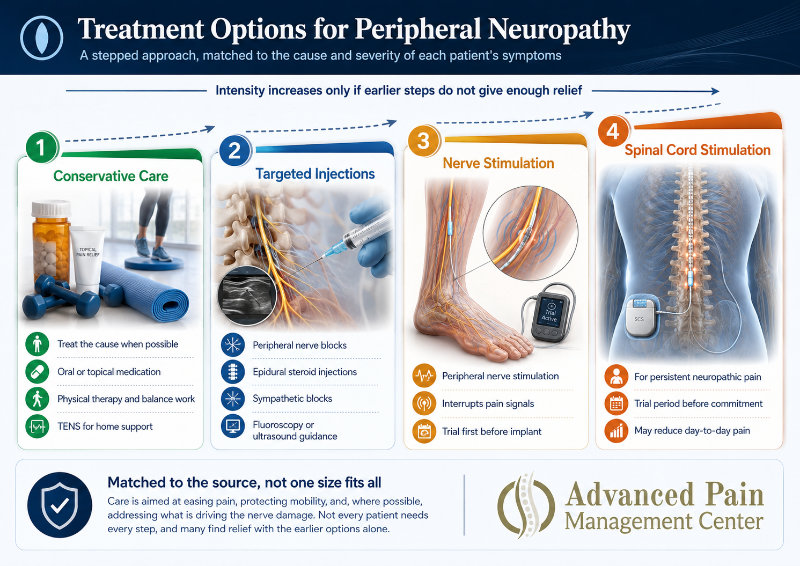
Managing the Cause and Conservative Care
The first step is often treating what is feeding the neuropathy, whether that means improved diabetes management, correcting a vitamin deficiency, or easing pressure on a nerve, usually in coordination with your other doctors. Provider-recommended movement, balance work, and outside physical therapy referrals may be discussed when appropriate to help reduce fall risk and support how you move. A TENS unit is sometimes added to help alter pain signaling at home.
Image-Guided Injections and Nerve Blocks
Targeted injections may help reduce inflammation and interrupt pain signals while also helping confirm which nerve is involved. A peripheral nerve block places medication around a specific nerve, an epidural steroid injection may help when leg symptoms trace back to compressed nerve roots in the lower back, and a sympathetic nerve block may help ease intense burning neuropathic pain in selected cases. All are placed with fluoroscopy or ultrasound guidance.
Peripheral Nerve Stimulation
When symptoms come from a specific peripheral nerve, peripheral nerve stimulation is designed to help interrupt the pain signal before it reaches the brain using a small electrode placed near that nerve. Patients try it during a roughly one-week trial with an external device, and only if the trial suggests meaningful relief does the conversation move toward implantation. The device is patient-controlled and can be removed if it does not deliver relief, which makes it a reversible option.
Spinal Cord Stimulation When Other Options Fall Short
For neuropathy that has not responded to other treatments, spinal cord stimulation delivers mild electrical pulses through leads placed near the spinal cord to change how pain reaches the brain. As with nerve stimulation, a trial period lets you assess whether the treatment helps before committing, and if pain improves, some patients may be able to discuss medication changes with their provider. It does not repair the nerve, but it may reduce day-to-day pain for the right candidate.
Every Neuropathy Service on the Menu at the SW Park Way Clinic
- Comprehensive neurological evaluation to identify the affected nerves and gauge severity
- Nerve conduction studies and electromyography when testing is indicated
- MRI or CT imaging to check for a structural cause
- Diagnostic nerve block to help pinpoint the nerve producing pain
- Coordinated management of contributing conditions such as diabetes or vitamin deficiency
- Oral and topical medication for symptom relief
- Transcutaneous electrical nerve stimulation (TENS) for at-home pain relief
- Peripheral nerve block for diagnosis and treatment of localized nerve pain
- Epidural steroid injection for radiating leg pain from compressed nerve roots
- Sympathetic nerve block for advanced burning neuropathic pain
- Fluoroscopy and ultrasound guidance for procedure planning
- Peripheral nerve stimulation for pain from a specific peripheral nerve
- Spinal cord stimulation for persistent, treatment-resistant nerve pain
- Cognitive behavioral support for the sleep, mood, and pain-coping side of neuropathy
- Ongoing evaluation and long-term management for progressing symptoms
Meet the Providers Caring for Neuropathy Patients at APMC
Neuropathy care at APMC is delivered by the team below, led by an interventional pain physician with more than two decades treating nerve pain. Patient reviews included below describe thorough visits, feeling valued, and compassionate staff, which is the tone the practice works to set at every visit.
Vladimir Fiks, MD, Interventional Pain Management Physician and Regenexx Provider
Dr. Fiks has led Advanced Pain Management Center since he opened it in 2000, and his approach centers on locating the source of nerve pain rather than covering it up. He graduated from Saratov University in Russia, completed an internship at Jefferson Frankford Hospital in Philadelphia, and finished both his anesthesiology residency and his pain management fellowship at Oregon Health and Science University here in Portland. He has advanced training in the varied symptoms of peripheral neuropathy and pairs medical and interventional therapies, from injections to neuromodulation, with outside physical therapy referrals and behavioral support coordinated as part of a whole-patient plan when appropriate. He is also a Regenexx provider and cares for patients in English, Spanish, and Russian.
Alberto Rodriguez, PA-C, MS, Pain Management Provider
With eighteen years across orthopedics, urgent care, family medicine, and pain management, Alberto Rodriguez, PA-C, MS brings unusually broad experience to nerve and spine care at the SW Park Way clinic. He earned his bachelor’s degree at Central Washington University and completed his physician assistant training and a Master of Science at Pacific University in Forest Grove, Oregon, in 2008. That range helps him sort out complex nerve problems, build individualized plans, and coordinate care around each patient’s goals. He believes good care starts with listening, so he takes the time to explain the condition and options in plain language and partner with patients on the decisions that follow.
Dmitriy Shore, PA-C, Pain Management Provider
Board certified by the National Commission on Certification of Physician Assistants since he finished at Oregon Health and Science University in 2000, Dmitriy Shore, PA-C has spent his whole career on chronic pain. Patients describe his care as patient-focused and compassionate, and some reviews single him out by name. A naturally curious clinician, he keeps current with continuing education and the pain management literature. Patients working with him can expect close attention to their symptoms and steady follow through on the plan.
Practical Answers for Portland Patients Before a First Neuropathy Visit
Does Dr. Fiks treat neuropathy in the hands and arms, or mainly the feet and legs?
Both. Neuropathy most often shows up first in the feet and lower legs, but the same evaluation and treatment approach applies to nerve pain in the hands, arms, and other areas. The exam and testing identify exactly which nerves are involved so the plan fits your pattern.
Can I be treated here if another doctor manages my diabetes?
Yes, and that is common. The team focuses on the nerve pain itself and coordinates with the physician handling your diabetes or other conditions, since controlling the underlying cause is part of protecting the nerves. You do not have to choose between the two.
Is telehealth an option for neuropathy visits at the Portland clinic?
For some consultations and follow-ups, yes. Advanced Pain Management Center offers telehealth, though in-person visits are still needed for the hands-on exam, testing, and any procedures. The front desk can tell you which of your appointments can be handled remotely.
Portland Neighborhoods and Westside Communities We Welcome Neuropathy Patients From
Neuropathy patients reach the SW Park Way clinic from across Portland and the surrounding Westside. Common areas we see patients from include:
- Portland, OR (97225 and surrounding zip codes)
- West Haven and Sylvan
- Cedar Mill
- Raleigh Hills
- Garden Home and Hillsdale
- Multnomah Village
- Northwest and Southwest Portland
- The Washington Park and Sylvan-Highlands area
- Beaverton
- Tigard
- Hillsboro
- Aloha
- Lake Oswego
- Bethany
- The wider Washington County Westside
How Neuropathy Quietly Reshapes a Portland Week
Peripheral neuropathy has a way of shrinking the parts of a Portland week people take for granted. It can turn a walk through Washington Park or the International Rose Test Garden into something to be endured, make the numbness louder on an evening stroll around Multnomah Village, or leave the burning in the feet worst at night once the house finally goes quiet. Some patients start avoiding stairs, uneven trails, or the grocery aisles at places like Cedar Hills Crossing because their balance no longer feels reliable. Care at APMC is aimed at reducing nerve pain, improving function where possible, and helping patients stay steadier on their feet. Weekday hours from 8:00 AM to 5:00 PM leave room to schedule an evaluation without upending the rest of your week.
What Portland Patients Have Shared About Their Neuropathy Care
“Finally I found one and am very pleased. Clean professional office, hip nurses (and funny), fresh equipment and tests. Not to mention thorough. My initial visit was lengthy, by no means rushed by nurses nor Dr. Fiks.”
“This was my 1st visit and so far so good. The staff is amazing, friendly and professional. As a patient I felt valued. Dr. Fiks has come up with a treatment plan for my chronic pain issues. Looking forward to my next visit.”
“Dr. Fiks is most knowledgeable about all areas of pain management. He is concerned about providing the best care for his patients using state of the art procedures. His staff is caring and available to assist in your treatment and in answering your questions. They are compassionate and attentive.”
Book a Neuropathy Evaluation Without Rearranging Your Whole Day
Call (503) 295-0730 or schedule online to start a consultation conversation with the Advanced Pain Management Center team. The front desk will walk you through what a first neuropathy evaluation involves, what records or imaging to bring, and how to plan your visit to the SW Park Way clinic around your day. If pain or numbness is making it hard to get around, let them know, and the front desk can help you look for an appointment time that works for your situation.
- Address: 10305 SW Park Way, Suite 300, Portland, OR 97225
- Website: https://apmconline.org/
- Hours: Monday to Friday, 8:00 AM to 5:00 PM. Closed Saturday and Sunday.
Call (503) 295-0730 | Request Your Portland Appointment
Advanced Pain Management Center 10305 SW Park Way, Suite 300, Portland, OR 97225
Frequently Asked Questions About Peripheral Neuropathy Treatment in Portland, OR
What is the most successful treatment for peripheral neuropathy?
There is no single treatment that works for everyone, because the best option depends on the cause, the nerves involved, and how severe the damage is. For many patients a combination works best, starting with managing the underlying cause and medication, then adding provider-recommended movement, outside physical therapy referrals, image-guided injections, or nerve stimulation as needed. Dr. Fiks matches the approach to your specific pattern rather than applying a one-size plan.
Is there a permanent cure for peripheral neuropathy?
In most cases neuropathy is managed rather than cured, since the symptoms come from nerve damage that may not fully reverse. When a clear underlying cause is caught early and corrected, symptoms can improve, but long-standing damage from diabetes or injury often needs ongoing management. The goal is to reduce pain, protect function, and keep the condition from getting worse.
What is the new treatment for peripheral neuropathy?
Neuromodulation is one option APMC may consider for selected patients whose pain has not responded to other care. Peripheral nerve stimulation and spinal cord stimulation both use mild electrical pulses to interrupt pain signals, and both include a trial period so you can assess whether the treatment helps before anything is implanted. They do not repair the nerve, but they may lower day-to-day pain for the right candidate.
What triggers peripheral neuropathy?
Diabetes is the most common trigger, followed by causes such as vitamin deficiencies, heavy alcohol use, thyroid and kidney problems, autoimmune disease, certain infections, chemotherapy, toxins, injury, and pressure on a nerve. Sometimes no cause is found even after testing, which is called idiopathic neuropathy. Identifying the trigger is a central part of the evaluation because it shapes the treatment plan.
How long does it take for peripheral neuropathy to heal?
How do you stop peripheral neuropathy from progressing?
The most effective way to slow it is to identify and control what is driving it, such as improved diabetes management, correcting a deficiency, or reducing alcohol or toxin exposure. Staying active with provider-recommended movement, protecting the feet, and using outside physical therapy when appropriate can also help. Early evaluation matters, because catching it sooner keeps more options open.
What are the 5 stages of peripheral neuropathy?
There is no single medically agreed five-stage system, but neuropathy is often described as progressing from early, intermittent numbness and tingling, to more constant pain, to loss of sensation and muscle weakness, and finally to significant balance and mobility problems in advanced cases. Not everyone moves through every phase or at the same pace. Where your symptoms fall on that range helps guide treatment.
How can you tell if peripheral neuropathy is healing?
Signs that things are improving can include less burning or shooting pain, fewer nighttime flares, steadier balance, and sensation slowly returning in numb areas. Improvement is often gradual and uneven, with better and worse days along the way. Tracking your symptoms between visits gives your provider useful information for adjusting the plan.
What are the worst symptoms of peripheral neuropathy?
For many people the hardest symptoms are constant burning or electric-shock pain, numbness that makes walking unsafe, and the balance problems and falls that can follow. Autonomic symptoms affecting blood pressure, digestion, or bladder function can also be serious. When symptoms reach this level, an evaluation is worthwhile because targeted treatment may still help.
What worsens peripheral neuropathy?
Poorly controlled blood sugar, continued heavy alcohol use, untreated vitamin deficiencies, and ignoring the condition tend to make it worse over time. Inactivity can add muscle weakness and further unsteadiness on top of the nerve symptoms. Addressing these factors, alongside treatment, is part of keeping the condition in check.
Why does peripheral neuropathy feel worse at night?
Many patients notice more burning, tingling, and shooting pain after they lie down, partly because there are fewer daytime distractions and partly due to how the nervous system processes pain signals at rest. Cooler skin temperature and certain sleeping positions can add to it. Treatment aimed at the underlying nerve pain may help calm nighttime flares and support better sleep for some patients.
Can peripheral neuropathy affect my balance and increase my risk of falling?
Yes. When the nerves in the feet lose sensation, the body has a harder time sensing the ground and reacting quickly, which can make walking feel unpredictable and raise the risk of falls. This is one reason the evaluation checks balance and coordination, and provider-recommended movement or outside physical therapy may be discussed when appropriate. Improving stability is an important treatment goal, not just pain relief.
Should I see a neurologist or a pain management physician for neuropathy?
Both can play a role, and many patients see more than one. A neurologist often focuses on diagnosing the type and cause of the nerve damage, while an interventional pain physician like Dr. Fiks focuses on relieving the pain and improving function with medical and image-guided treatments. If you are looking for a neuropathy specialist in Portland, APMC can evaluate your symptoms and coordinate with other clinicians as needed.
Does peripheral neuropathy usually start in the feet?
Often, yes. Because the condition tends to affect the longest nerves first, symptoms frequently begin in the toes and feet and gradually move upward into the legs, and sometimes later into the hands. This feet-first pattern is one of the clues Dr. Fiks looks for during the evaluation, and noticing it early gives treatment a better chance to help.
Can peripheral neuropathy be mistaken for other conditions like sciatica?
Yes, and sorting that out is an important part of the workup. Sciatica and spinal nerve compression can cause leg pain, numbness, and tingling that resemble neuropathy, but they are treated differently. The exam, testing, and sometimes a diagnostic nerve block help confirm whether the symptoms are truly from peripheral neuropathy or from another source.
Peripheral Neuropathy Guides and Resources for Portland Patients
- Severe Peripheral Neuropathy in the Lower Legs: How Image-Guided
- Is It Possible to Reverse the Effects of Peripheral Neuropathy?
- Can Peripheral Neuropathy Resolve Spontaneously?
- Peripheral Neuropathy Pain Management: 7 Key Benefits of Physical Therapy
- The Different Classifications of Peripheral Neuropathy
- Classifying Peripheral Neuropathy
- A Closer Look at Your Peripheral Nerves
- Distinguishing Between Neuropathic and Nociceptive Pain
- 3 Signs It’s Time to Consider a Spinal Cord Stimulator
- What Peripheral Nerve Stimulation Is and How It Differs From Spinal Cord Stimulation
- Why Is a Spinal Cord Stimulator Trial Necessary and How Does It Work?
- How Does a Spinal Cord Stimulator Work?
- Am I a Candidate for a Spinal Cord Stimulator?
Neuropathy Care That Fits How Portland Patients Actually Live
For anyone tired of having their nerve pain brushed aside, this is a practice that will take the time to understand exactly where the numbness, burning, or weakness is coming from, explain your medication, injection, and nerve stimulation options in plain language, and build a plan aimed at easing pain and helping you stay steadier on your feet where possible. Get in touch when it works for you, and the front desk will help you set up that first visit to the Portland clinic.
Begin Your Neuropathy Evaluation at the Portland Clinic
Request Your Portland Appointment | Call (503) 295-0730
Advanced Pain Management Center 10305 SW Park Way, Suite 300, Portland, OR 97225
Hours:
- Monday to Friday: 8:00 AM to 5:00 PM
- Saturday: Closed
- Sunday: Closed
Nerve damage and disease can be debilitating. Peripheral neuropathy most commonly affects people over 55, and up to 4% of people in this age group experience symptoms. If untreated, peripheral neuropathy can severely affect your quality of life, but it doesn’t have to be that way. Vladimir Fiks, MD, is a leading interventional pain management physician at Advanced Pain Management Center in Portland, Oregon, also serving the surrounding areas of Aloha, Hillsboro, Beaverton, Tigard & Lake Oswego. With his team, he treats all peripheral neuropathies to provide ongoing pain relief. Book your appointment through this website or over the phone.
Peripheral Neuropathy Q&A
What is peripheral neuropathy?
Peripheral nerves are nerves outside of the central nervous system (the brain and spinal cord). They carry messages between the central nervous system and the rest of the body — tissues such as the internal organs, muscles, and skin.
Peripheral neuropathy is a term used to describe the problems that occur when the peripheral nerves become diseased or damaged. Dr. Fiks has advanced training in treating the varied symptoms that result from peripheral neuropathy.
How do doctors classify peripheral neuropathy?
Doctors classify peripheral neuropathy in two ways: by severity or by the type of nerve they affect.
Severity
There are specific terms to describe the severity of peripheral neuropathy. Mononeuropathy affects one type of nerve in one area, while multiple mononeuropathies affect one type of nerve but in two or more unique areas. Polyneuropathy affects many types of nerves at the same time.
Nerve type
Each nerve in the peripheral system has a unique function. Motor nerves control muscle movement. Autonomic nerves control internal organs and affect functions such as blood pressure, heart rate, and digestion. Sensory nerves determine sensations, like temperature, touch, and pain.
Through his thorough evaluation, Dr. Fiks identifies the nerves affected and the severity of your peripheral neuropathy to create a comprehensive treatment program.
What are the symptoms of peripheral neuropathy?
Because each nerve has a unique function, your symptoms will depend on which nerves are damaged. You might experience:
- Stabbing, burning, or tingling pain
- Extreme sensitivity
- Lack of coordination
- Frequent falls
- Muscle weakness
- Muscle paralysis
- Weighted feeling in hands and feet, like wearing gloves or socks
- Numbness, tingling, or prickling in hands and feet
- Sweating abnormalities
- Intolerance to heat
- Digestive problems
- Bowel or bladder issues
- Lightheadedness caused by blood pressure changes
If you experience these symptoms, speak with Dr. Fiks. He treats pain and other symptoms to make life more comfortable for you.
Who is at risk of peripheral neuropathy?
Some people are more at risk of developing peripheral neuropathy than others. Common contributing factors include:
- Alcohol abuse
- Deficiency of certain B vitamins
- Kidney or liver problems
- Autoimmune diseases, like lupus and rheumatoid arthritis
- Family history of neuropathy
- Toxin exposure
- Thyroid disorders
- Diabetes
- Repetitive strain injuries
- Chronic infection, like Lyme disease or hepatitis B
Peripheral neuropathy can cause uncomfortable, often painful symptoms. Advanced Pain Management Center offers expert corrective measures to treat pain and target the root cause. Call the practice today or book through the online scheduling tool.