
Minimally Invasive Spinal Stenosis Treatment in Portland, OR From an Interventional Pain Specialist
- Home
- Minimally Invasive Spinal Stenosis Treatment in Portland, OR From an Interventional Pain Specialist
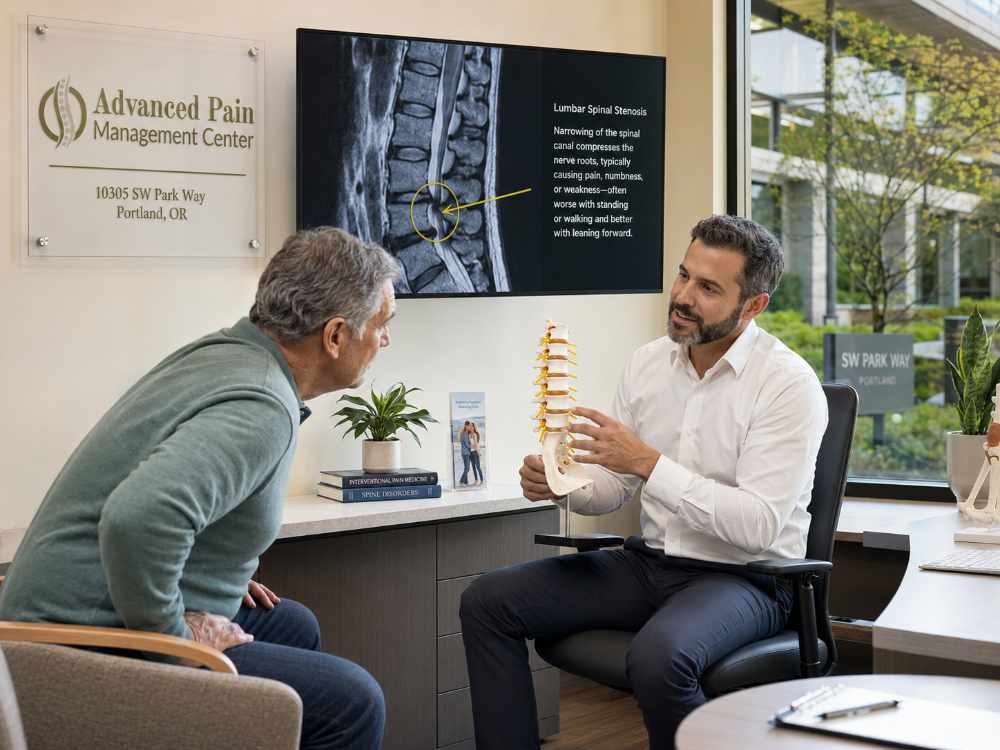
If standing or walking brings on lower back pain, numbness, or heaviness in the legs that eases the moment you sit or lean forward on a shopping cart, spinal stenosis may be the reason. It is one of the most common spine conditions in adults over 50, and it tends to worsen the longer it goes untreated. Advanced Pain Management Center treats spinal stenosis at 10305 SW Park Way, Suite 300 in Portland, in the West Haven medical corridor beside Providence St. Vincent Medical Center. Care is led by Vladimir Fiks, MD, an interventional pain management physician and Regenexx provider, alongside Dmitriy Shore, PA-C and Alberto Rodriguez, PA-C, using minimally invasive and interventional options such as spinal decompression, epidural and other spinal injections, and spinal cord stimulation to relieve nerve pressure without major back surgery.
Book Your Portland Consultation | Call (503) 295-0730
Understanding Spinal Stenosis and Why It Narrows the Spinal Canal
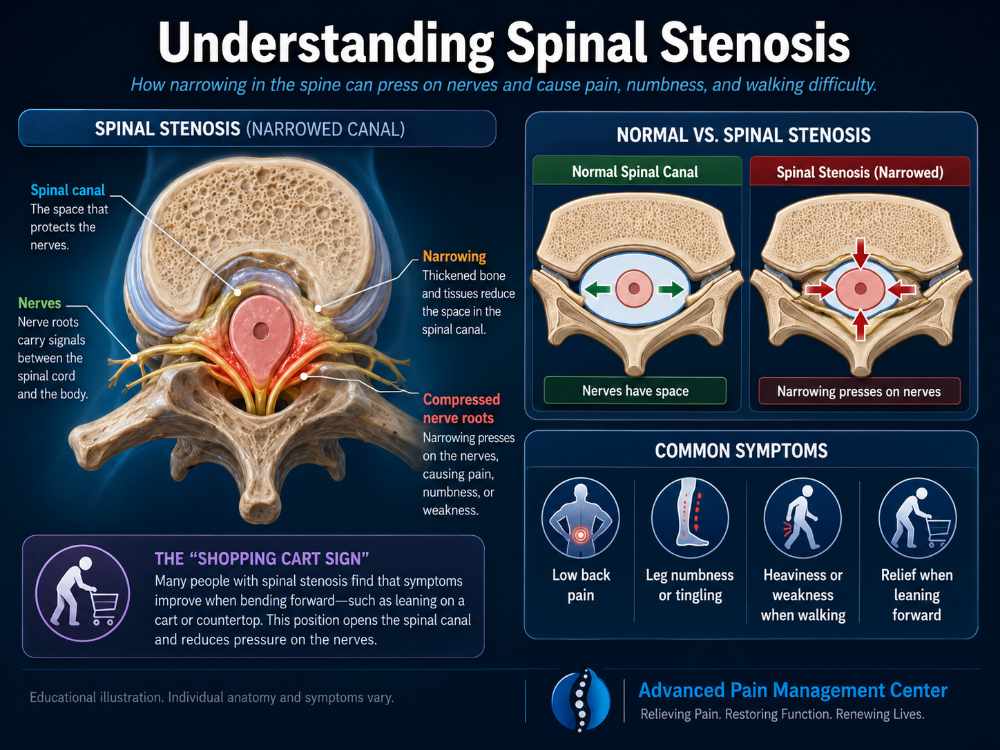
Spinal stenosis is the narrowing of the spaces inside the spine, most often in the lower back, which places pressure on the spinal cord and the nerve roots that travel through the canal. In most patients it develops slowly with age, as thickened ligaments, bone spurs from arthritis, and bulging or degenerating discs gradually crowd the space the nerves need. Because the narrowing worsens when the spine straightens and eases when it flexes forward, many people first notice it as pain or fatigue that comes on while standing or walking and quiets when they sit down or lean on something. This pattern, sometimes called the shopping cart sign, is one of the clearest hints that the canal, rather than a muscle or a single disc, is the source of the trouble.
Parking and Directions to the SW Park Way Clinic for Portland Patients
Our Portland clinic sits at 10305 SW Park Way, Suite 300, in the West Haven area on the west side of the city, directly beside Providence St. Vincent Medical Center. For patients coming from Beaverton, Cedar Mill, Raleigh Hills, or Northwest Portland, the office is a short drive by way of US-26, the Sunset Highway, and Highway 217, and there is no need to navigate the dense medical towers or parking structures closer to downtown. Ground level access and on site parking keep arrival simple, which matters when standing and walking are already uncomfortable.
That location is a practical advantage for someone managing spinal stenosis. The clinic offers a private, outpatient setting inside an established medical corridor rather than a sprawling hospital campus, so the walk from the car to the door is short and the building is easy to find. Patients from across the Portland metro, including the Westside suburbs and nearby communities such as Tigard and Lake Oswego, choose the SW Park Way office specifically because it delivers specialized spine care close to home without a stressful commute.
What Makes Dr. Fiks the Right Choice for Spinal Stenosis Care in Portland
Choosing where to go for spinal stenosis is a decision most Portland patients make carefully, because the wrong path can mean unnecessary surgery or years of masked symptoms. Patients who choose advanced pain management for spinal stenosis at APMC tend to point to the same reasons, and those reasons are reflected in the practice’s strong Google review standing, where patients repeatedly mention feeling listened to and not rushed.
Fellowship-trained interventional pain physician:
Dr. Vladimir Fiks completed both his anesthesiology residency and a pain management fellowship at Oregon Health and Science University in Portland, and he has led the practice since it opened in 2000.
Decompression expertise focused on stenosis:
Dr. Fiks focuses on minimally invasive techniques aimed squarely at the nerve pressure stenosis creates, including the minimally invasive MILD procedure, tubular foraminotomy, interspinous distraction and fusion, and facet fusion.
The full ladder of options in one practice:
From spinal injections to decompression to spinal cord stimulation and, for selected advanced cases, minimally invasive spinal fusion, so care can escalate only as far as your condition requires.
A focus on the cause, not just the symptoms:
The goal is to relieve the actual source of nerve pressure and improve how you move, rather than relying on long-term painkiller prescriptions.
Image-guided precision:
Injections and procedures are placed with fluoroscopy or ultrasound guidance so treatment reaches the exact level of the spine causing symptoms.
Minimally invasive first:
The procedures make liberal use of numbing medication and light sedation, given by IV or orally, to keep patients comfortable during treatment and support a smoother recovery.
Coverage that works for older patients:
These minimally invasive procedures, not only the MILD decompression, are covered by Medicare, and the office works with most major insurance plans.
A whole-patient approach to recovery:
The team looks beyond a single procedure to your overall recovery and function, with cognitive behavioral support available as part of a broader plan, and cares for patients in English, Spanish, and Russian.
An accessible outpatient location:
The SW Park Way clinic beside Providence St. Vincent offers ground level access and easy parking, a real benefit when walking any distance is painful.
How Dr. Fiks Diagnoses Spinal Stenosis Before Recommending Treatment
A Thorough Consultation and Symptom History
Every evaluation begins with a detailed conversation about your history, how long the pain has been present, and what makes it better or worse. Dr. Fiks pays close attention to the telltale patterns of stenosis, such as leg symptoms that appear with standing or walking and ease with sitting or leaning forward. Understanding your daily activities and goals early helps shape a plan that fits your life, not just an image on a scan.
A Focused Physical Examination
A hands on exam checks strength, reflexes, sensation, balance, and how far you can comfortably walk and stand. These findings help confirm that nerve compression, rather than a muscle strain or a single disc, is driving the symptoms. The exam also flags any signs that call for more urgent attention, which guides how quickly and how aggressively to proceed.
Imaging to Confirm and Locate the Narrowing
Matching the Right Patient to the Right Treatment
Not every spinal stenosis patient is a candidate for the same procedure, so the final step is deciding which option fits your specific narrowing, symptoms, and overall health. Dr. Fiks generally starts with the least invasive approach likely to help and reserves more involved procedures for cases that need them. This candidacy discussion is honest about what each option can and cannot do.
Spinal Stenosis Treatments Dr. Fiks May Recommend
APMC offers minimally invasive and interventional options designed to relieve nerve pressure, reduce inflammation, manage pain, and improve mobility for appropriate spinal stenosis patients. Care is organized into the four areas below, matched to the severity and source of each patient’s symptoms.
Spinal Decompression, the Primary Treatment for Stenosis
Decompression is the treatment aimed most directly at spinal stenosis, because it works to restore the space the nerves need. Dr. Fiks uses direct, minimally invasive decompression techniques that remove the bone or thickened ligament crowding the canal, including the MILD procedure and tubular foraminotomy, and he can add interspinous distraction and fusion or facet fusion when a segment also needs to be stabilized. For lumbar stenosis, the MILD procedure removes excess ligament tissue through an incision smaller than a baby aspirin, typically without general anesthesia, and many patients return to normal activity within about 24 hours.
Spinal Injections to Calm Inflammation and Nerve Pain
Spinal Cord Stimulation for Persistent Nerve Pain
Minimally Invasive Spinal Fusion for Selected Advanced Cases
The Full Range of Spinal Stenosis Care Options at APMC
- Direct spinal decompression to remove bone or thickened ligament crowding the canal
- The minimally invasive mild procedure for lumbar spinal stenosis
- Tubular foraminotomy to open the space around a compressed nerve root
- Facet fusion to stabilize a painful or unstable spinal segment
- Epidural steroid injections for stenosis related nerve and leg pain
- Facet joint injections and medial branch blocks for overlapping facet pain
- Radiofrequency ablation for longer lasting relief when pain sources overlap
- Selective nerve root blocks to help pinpoint the affected level
- Spinal cord stimulation for persistent nerve pain when other options have not helped
- Minimally invasive spinal fusion for selected cases with instability
- Imaging-guided procedure planning with fluoroscopy or ultrasound
- Cognitive behavioral support as part of a whole-patient plan
- Ongoing evaluation and management for progressing or recurring symptoms
Dr. Fiks and the APMC Team Treating Spinal Stenosis Patients
Spinal stenosis care at APMC is delivered by the providers below, led by an interventional pain physician with decades of experience treating the spine.
Vladimir Fiks, MD: Interventional Pain Management Physician and Regenexx Provider
Alberto Rodriguez, PA-C: Pain Management Provider
Dmitriy Shore, PA-C: Pain Management Provider
Quick Questions Portland Patients Ask About Spinal Stenosis Care
Do I need a referral from another doctor to be seen for spinal stenosis?
How quickly can a Portland patient get in for a spinal stenosis evaluation?
The office schedules new spinal stenosis evaluations at the SW Park Way clinic on a rolling basis, and the team tries to accommodate patients dealing with significant pain as promptly as possible. Calling (503) 295-0730 is the fastest way to find the earliest available appointment.
Is the SW Park Way clinic easy to reach and park at if walking is painful?
Yes. The clinic sits in the West Haven medical corridor beside Providence St. Vincent, with ground level access and on-site parking, so the walk from the car to the door is short. That accessibility is one reason Portland patients with stenosis choose the office over larger hospital campuses.
Portland and Nearby Areas Where Our Spinal Stenosis Patients Live
Patients come to the SW Park Way clinic for spinal stenosis care from across Portland and the surrounding Westside. Common areas we see patients from include:
- Portland, OR (97225 and surrounding zip codes)
- West Haven and Sylvan
- Cedar Mill
- Raleigh Hills
- Garden Home and Hillsdale
- Multnomah Village
- Northwest and Southwest Portland
- The Washington Park and Sylvan-Highlands area
- Beaverton
- Tigard
- Lake Oswego
- Hillsboro
- Bethany
- Aloha and the wider Washington County Westside
How Spinal Stenosis Shows Up in Everyday Portland Life
Patient Reviews That Reflect the APMC Experience
“This is a new doc for us and we are very happy so far. Great staff, great nurses, and a great doctor. We are happy with the change and look forward to working with them. They made us feel important and listened to all our questions. They didn’t rush us in our initial appointment, which was very appreciated. Keep up the good work everyone.”
“I have been a patient of Mr. Shore and Dr. Fiks for several years. I find them both to listen to my issues and work with me to find a solution that works best for my body and specific health concerns. Mr. Shore is always friendly and willing to adjust medications as he sees necessary. Thank you.”
“My interaction with Advanced Pain Management Center has been awesome. I was finally down to the pain amount that I can deal with every day, which I waited many years to find someone who could make happen. The people there are wonderful and kind, and I would refer my family there if they needed it.”
Set Up a Spinal Stenosis Evaluation at Our Portland Clinic
- Address: 10305 SW Park Way, Suite 300, Portland, OR 97225
- Website: https://apmconline.org/
- Hours: Monday to Friday, 8:00 AM to 5:00 PM. Closed Saturday and Sunday.
Advanced Pain Management Center 10305 SW Park Way, Suite 300, Portland, OR 97225
Frequently Asked Questions About Spinal Stenosis Treatment in Portland, OR
What are the first signs of spinal stenosis?
Who should not have spinal decompression?
How do I know if I need spinal decompression?
Does spinal stenosis get worse if it is not treated?
How long does it take to see results from spinal decompression?
With the minimally invasive mild procedure, many patients feel improvement within days and often continue to improve over the following year. Recovery from more involved procedures may take longer. A short home physical therapy program is frequently recommended to support the best possible outcome.
What is the next step if spinal injections don't work?
If injections provide little or only brief relief, that information still helps guide care. The next step may be a decompression procedure to address the narrowing directly, or spinal cord stimulation for persistent nerve pain. Dr. Fiks uses the response to injections as one piece of the larger treatment picture.
What should I avoid after a spinal injection?
For the first day or two, it is wise to avoid strenuous activity, heavy lifting, and long periods of intense exercise while the area settles. Most patients can return to light daily activity soon after. Your provider will give specific instructions based on the type of injection you received.
What qualifies you for a spinal cord stimulator?
What kind of pain does a spinal cord stimulator help?
It is most helpful for ongoing nerve related pain, including the radiating leg pain and burning or tingling that stenosis and other spine conditions can cause. It works by interrupting pain signals before they reach the brain, which can reduce how much pain you feel day to day.
What helps spinal fusion heal faster?
Following your post-procedure instructions closely is the biggest factor: protecting the area, avoiding smoking, staying active within the limits you are given, and keeping your follow-up visits. Minimally invasive fusion generally involves less tissue disruption than traditional surgery, which can support a smoother recovery.
How is spinal stenosis different from a herniated disc?
Both can press on nerves, but they are not the same. Spinal stenosis is a narrowing of the spinal canal itself, usually from gradual changes like thickened ligaments and arthritis, while a herniated disc is a single disc bulging or leaking against a nerve. Stenosis pain classically eases when you lean forward, and imaging helps tell the two apart.
Does APMC treat neck stenosis or only lower back stenosis?
The lower back is the most common site of stenosis and the focus of decompression procedures like mild. For narrowing in the neck, the practice offers image-guided options such as cervical epidural steroid injections to manage nerve related pain. Your evaluation will identify which region is affected and which treatments fit.
Is the mild decompression procedure covered by Medicare in Portland?
What can I do at home to manage spinal stenosis between visits?
Many patients find relief in positions and activities that flex the spine slightly forward, such as using a stationary bike or leaning on a cart while walking, along with gentle core and posture work. These steps can ease symptoms but do not address the narrowing itself, so they work best alongside a treatment plan. Your provider can tailor safe recommendations to your case.
Are Regenexx or regenerative treatments used for spinal stenosis?
Regenexx regenerative procedures are used primarily for orthopedic and joint conditions and certain spine-related pain, rather than as a way to widen a narrowed canal. For spinal stenosis itself, decompression and injections are the primary tools. Dr. Fiks, who is also a Regenexx provider, can explain where regenerative options may fit into a broader plan.
Spinal Stenosis Relief in Portland Starts With the Right Diagnosis
Request Your Spinal Stenosis Evaluation Today
Book Your Portland Consultation | Call (503) 295-0730
Advanced Pain Management Center 10305 SW Park Way, Suite 300, Portland, OR 97225
Hours:
- Monday to Friday: 8:00 AM to 5:00 PM
- Saturday: Closed
- Sunday: Closed