
Interventional Pain Management for Knee Pain in Portland, OR: Nerve Blocks, Genicular Nerve Treatment, and Regenexx
- Home
- Interventional Pain Management for Knee Pain in Portland, OR: Nerve Blocks, Genicular Nerve Treatment, and Regenexx
Last Updated: 8/31/26
Chronic knee pain has a way of shrinking your world, from the walking loop at Tom McCall Waterfront Park to a round at Portland Golf Club. Advanced Pain Management Center in Portland, Oregon, offers procedure-based options for patients whose symptoms have not improved with conservative care. Led by Regenexx physician Vladimir Fiks, MD, the team uses targeted, minimally invasive procedures to evaluate and treat specific sources of knee pain when appropriate. This page explains common causes, how APMC evaluates knee pain, which procedures may be considered, who may be a candidate, and what Portland patients can expect.
Schedule Your Portland Knee Consultation | Call (503) 295-0730
An important note up front: these are procedure-based treatments, not opioid prescriptions.
The Short Answer for Portland Knee Pain Patients
Interventional pain management for knee pain uses targeted, image-guided procedures to address a joint, tissue, or nerve that may be contributing to pain. At APMC, options may include diagnostic or therapeutic nerve blocks, genicular nerve treatment, radiofrequency ablation, peripheral nerve stimulation for selected chronic nerve-related pain, and Regenexx procedures using autologous blood or bone marrow concentrate. A provider examines the knee and reviews appropriate imaging before recommending a procedure. The goal is to reduce pain and improve function while helping appropriate patients explore options before surgery. Results vary.
★ Since opening in 2000, APMC has treated patients from Oregon and Washington. The Regenexx network also maintains a patient registry that tracks self-reported outcomes. Registry results do not predict how an individual patient will respond.
What Interventional Pain Management for the Knee Actually Means
APMC describes interventional pain management as the middle ground between medication-based symptom control and major surgery. Rather than centering care on long-term medication use, the team offers targeted, minimally invasive procedures intended to evaluate and treat joints, tissues, or nerves that may be contributing to pain. Many of these procedures are performed in an outpatient setting without a hospital stay or a large incision.

This distinction matters. Interventional care is procedure-based. Diagnostic and therapeutic injections may help evaluate a pain source and deliver treatment to a joint or nerve. Image guidance supports accurate needle placement. Treatment goals may include reducing pain and improving mobility and function, but results, recovery, and the duration of relief vary by diagnosis and procedure. Whether a given treatment fits depends on your diagnosis, which is why evaluation always comes first.
What Causes Chronic Knee Pain
APMC notes that chronic knee pain can interfere with walking, sleep, work, exercise, household tasks, and time with family, and that cutting back on activity to avoid pain can actually lead to more stiffness and weakness. The causes the practice treats include:
- Osteoarthritis and age-related joint degeneration
- Meniscus damage or tears
- ACL, PCL, MCL, or LCL sprains, tears, or degeneration
- Tendinopathy and other tendon injuries
- Cartilage injuries or deterioration
- Older sports injuries or repetitive overuse
- Persistent pain after knee surgery, including after total knee replacement
- Inflammation or damage involving the genicular, saphenous, or related nerves around the knee
- End-stage knee arthritis when surgery is not an option
Common symptoms include chronic or activity-related pain, morning stiffness, swelling after activity, sharp pain with movement, a sense that the knee may give out, difficulty walking or climbing stairs, and burning or electric nerve-type pain when nerves are involved.
How APMC Finds the Source of Your Knee Pain
Effective treatment starts with an accurate diagnosis, and APMC builds a complete clinical picture before recommending anything. The process begins with a consultation to understand your condition, medical history, symptoms, and goals, followed by a focused physical examination of how pain affects movement and function.
- X-rays may show bone changes and alignment problems
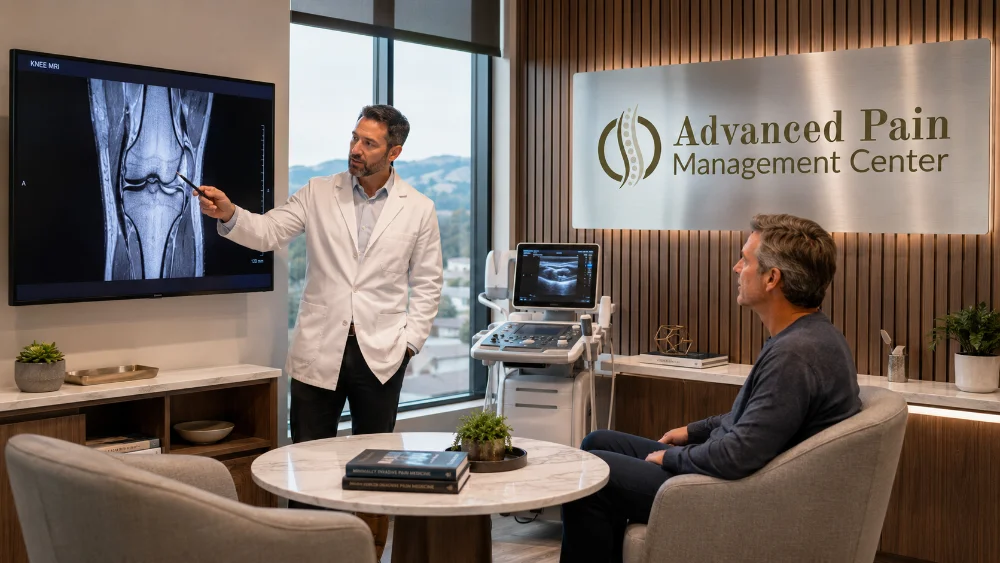
- MRI may show cartilage, menisci, ligaments, tendons, and other soft tissues around the knee
- High-resolution ultrasound may help locate and assess soft-tissue damage
- Diagnostic injections with local anesthetic may help determine whether a particular nerve or structure is contributing to pain
From there, the physician reviews the findings and imaging to decide whether a nerve-directed treatment, a bone marrow concentrate procedure, or a platelet-based procedure is appropriate. Treatment plans are customized to your condition, anatomy, activity needs, and recovery goals.
“I’ve been a Patient at Advanced Pain Management for over 4 years. Dr. Fiks, Mr. Shore and the other staff members are wonderful and a professional group of people! They listen to all of my concerns and explain things to me in detail which I really appreciate. The treatments have helped me so much, I can’t thank them enough!” – Angela NelsonKnee Pain Procedures Offered at APMC
APMC offers a focused set of interventional and regenerative procedures for the knee. Each is minimally invasive, image-guided where appropriate, and chosen based on the diagnosis. None of them is an opioid prescription.
Peripheral and Genicular Nerve Blocks

A peripheral nerve block places local anesthetic, and sometimes steroid, at a specific nerve to interrupt the pain signals traveling from the knee to the brain. APMC uses these blocks in two ways. A diagnostic block may help show whether a particular nerve or branch is contributing to the pain. If it produces meaningful temporary relief, the physician may consider that response alongside the examination and imaging when deciding whether another nerve-directed treatment is appropriate. A therapeutic block may also provide temporary relief.
For the knee, treatment commonly targets the genicular nerve branches, and sometimes the saphenous nerve or its branches. Because relief from a diagnostic block is usually temporary, the response may help the physician decide whether another nerve-directed procedure, such as radiofrequency ablation, is appropriate. This is a targeted nerve procedure, not a prescription for opioid pain medication.
When a Positive Block May Lead to Another Treatment Option
If a diagnostic genicular nerve block produces meaningful temporary relief, APMC may consider radiofrequency ablation (RFA). RFA uses radiofrequency energy to create a controlled lesion on a targeted pain-transmitting nerve. APMC reports that some patients experience relief for six to 12 months, but the duration varies and is not guaranteed. The physician determines whether repeating the procedure is appropriate. RFA is performed as an outpatient procedure under image guidance.
Peripheral Nerve Stimulation for Chronic Knee Pain
APMC also offers peripheral nerve stimulation for selected patients with chronic nerve-related knee pain, particularly persistent pain following knee replacement or other knee surgery. Peripheral nerve stimulation uses a small electrode positioned near a targeted peripheral nerve to deliver electrical stimulation intended to modify pain signaling. It may be considered when chronic pain appears to have a nerve-related component and other treatments have not provided adequate relief. The physician determines whether PNS is appropriate based on the patient’s symptoms, examination, previous treatment, and suspected source of pain.
Regenexx for the Knee

Regenexx is a group of nonsurgical, injection-based procedures that use autologous blood or bone marrow concentrate. The injectate is placed into the targeted area using ultrasound or fluoroscopic guidance when appropriate. Dr. Fiks is a Regenexx physician within an interventional orthopedics network focused on musculoskeletal conditions. APMC evaluates Regenexx procedures for conditions such as knee osteoarthritis, meniscus injuries, ligament sprains or tears, tendinopathy, and other cartilage, tendon, or ligament problems. Some patients explore these procedures before joint-replacement surgery, but candidacy depends on the diagnosis and severity of the condition.
Long-Term Research on Bone Marrow Concentrate and Knee Replacement
Long-term research has examined whether subchondral bone marrow concentrate may help some patients with knee osteoarthritis postpone knee replacement. In a prospective randomized study led by Philippe Hernigou, MD, 140 patients who were planning bilateral knee replacement received total knee arthroplasty in one knee and a subchondral bone marrow concentrate injection in the other. At an average follow-up of 15 years, 25 of the 140 BMC-treated knees had subsequently undergone knee replacement. The authors concluded that subchondral bone marrow concentrate had helped postpone or avoid knee replacement in the treated knee for some patients in the study. These findings do not mean that bone marrow concentrate will prevent knee replacement for every patient, and results from this specific research protocol should not be assumed to predict an individual patient’s response. Candidacy depends on the diagnosis, severity of joint damage, alignment, imaging findings, and other clinical factors.
Regenexx SD is a same-day bone marrow concentrate procedure. Bone marrow is drawn from the back of the hip, concentrated, and reinjected during the same visit. Regenexx SCP and Platelet Lysate are prepared from the patient’s own blood. Dr. Fiks reviews the intended use, limitations, risks, and available alternatives before treatment.
APMC reports that many patients resume light activities and work after approximately five to seven days and may return to sports after approximately six to eight weeks. Individual restrictions and recovery timelines depend on the procedure, condition, and provider’s instructions. Follow-up may include a referral to physical therapy, home exercise, bracing, or taping. Candidacy is determined by the physician after reviewing your symptoms, exam, and imaging, and APMC notes that a complete, severe tear causing total instability may still require surgical reconstruction.
APMC’s Regenexx knee page reports registry data from 26,418 knee patients as of June 5, 2026. Patients reported average function scores increasing from 57% before treatment to as high as 76% of optimal function afterward. Average pain scores changed from 4.2 out of 10 before treatment to 2.3 out of 10 at one month. These are self-reported registry outcomes and do not predict how an individual patient will respond.
“Staff was extremely nice and helpful. They got me in fast and I was impressed with everyone I met.”
Who Is a Candidate for Interventional Knee Care
These procedures tend to fit patients who want a middle path between conservative care and surgery. You may be a candidate if:
- Knee pain has persisted despite rest, activity changes, physical therapy, or medication
- You want to avoid or delay knee surgery, including total knee replacement
- A diagnostic nerve block produces temporary relief suggesting that a particular nerve may be contributing to your pain
- You are interested in a less invasive procedure using autologous blood or bone marrow concentrate, when appropriate
- You have arthritis, a meniscus or ligament injury, tendinopathy, or ongoing pain after a prior knee surgery
A provider confirms whether any procedure is appropriate after reviewing your symptoms, examination, and imaging. Some situations, such as a complete, severe ligament tear with total instability, may still be better served by surgery, and APMC will tell you when that is the case.
Why Portland Patients Choose Advanced Pain Management Center
- A Regenexx physician on staff: Dr. Fiks is part of the Regenexx interventional orthopedics network and performs image-guided musculoskeletal injections
- A source-first philosophy: the team evaluates possible structural and nerve-related contributors to pain before recommending treatment and refers for surgical evaluation when appropriate
- Procedure-based, not opioid-based: care centers on targeted injections and image-guided procedures rather than opioid prescriptions
- Image-guided precision: complex injections are placed using ultrasound or fluoroscopic guidance to support accurate targeting
- An integrative approach: Dr. Fiks practices both medical and interventional pain therapies and may coordinate supportive care with outside providers when appropriate
- Established Portland roots: APMC has served patients across Oregon and Washington since 2000, in a warm and inclusive setting
- Multilingual care: Dr. Fiks speaks English, Spanish, and Russian
The Providers Behind Your Knee Care
Interventional knee care at APMC is supported by the team below and led by Dr. Fiks.
Dr. Fiks is an interventional pain management physician and a Regenexx physician at APMC. He graduated from Saratov University in Saratov, Russia, completed an internship at Jefferson Frankford Hospital in Philadelphia, and then completed both an anesthesiology residency and a pain management fellowship at Oregon Health & Science University in Portland. Using an integrative approach, he practices both medical and interventional pain therapies, performs complex image-guided orthopedic injections, and emphasizes overall physical and mental wellness in recovery. Dr. Fiks speaks Spanish, English, and Russian.
Alberto Rodriguez earned a Master of Science degree and completed his Physician Assistant studies at Pacific University in 2008. Over the past 18 years he has cared for patients across orthopedics, urgent care, family medicine, and pain management, which helps him evaluate complex conditions and build individualized plans. He believes exceptional care begins with listening, and focuses on educating patients and partnering with them in decisions about their treatment.
Quick Answers Before Your Visit
Is interventional knee treatment the same as surgery?
No. These are minimally invasive, mostly outpatient procedures such as nerve blocks and Regenexx injections, designed as a middle ground between medication and surgery. Many patients pursue them specifically to avoid or delay a knee operation.
Do I need imaging or a referral before treatment?
Care begins with a consultation and physical exam, and imaging such as X-ray, MRI, or ultrasound may be used to evaluate possible sources of pain. A diagnostic nerve block may also be performed before certain treatments. You can call APMC to start the process and ask whether your insurance requires a referral or prior authorization.
Where is APMC, and who does it serve?
APMC is located at 10305 SW Park Way, Suite 300, Portland, OR 97225, and serves Portland and surrounding areas including Aloha, Hillsboro, Beaverton, Tigard, and Lake Oswego.
What to Expect, From Consultation to Recovery
Most knee patients follow a similar path. It starts with a consultation and exam, along with any needed X-ray, MRI, or ultrasound, to evaluate possible sources of pain. If nerve-related pain is suspected, a diagnostic block may help determine whether a particular nerve is contributing. Depending on the findings, the plan may involve a therapeutic nerve block, radiofrequency ablation, peripheral nerve stimulation, or a Regenexx procedure.
Procedures are performed on an outpatient basis. For Regenexx, local anesthesia numbs the area, some patients undergoing a bone marrow procedure may receive an oral sedative, and the joint may feel sore afterward, with light activity limited on the first day. For radiofrequency ablation, patients generally receive intravenous sedation, should not drive on the day of the procedure, and are advised to avoid strenuous activity for the first 24 hours. Your provider reviews personalized aftercare, and recovery timelines vary by procedure and patient.
★ APMC’s knee procedures are image-guided and procedure-based. The focus is on targeting structures and nerves that may be contributing to pain, not on prescribing opioids.
Portland Neighborhoods and Nearby Communities APMC Serves
Patients travel to the SW Park Way office from across the Portland metro. Common areas include:
- Portland, OR (97225) and the West Hills
- Southwest Portland and Raleigh Hills
- Garden Home and the Portland Golf Club area
- Nob Hill and the Alphabet District along NW 23rd Avenue
- Downtown Portland and the Tom McCall Waterfront Park area
- Cedar Mill and Cedar Hills
- Beaverton
- Aloha
- Hillsboro
- Tigard
- Lake Oswego
- Communities along Highway 26 and Barnes Road
Where the Clinic Sits Near Portland’s West Side
Start With a Knee Pain Consultation
Call (503) 295-0730 or schedule a consultation online with the Advanced Pain Management Center team. The front desk can explain appointment logistics, what records or imaging to bring, and how to plan the trip from your part of the Portland area. The provider determines whether a diagnostic block or Regenexx consultation is appropriate.
- Address: 10305 SW Park Way, Suite 300, Portland, OR 97225
- Website: https://apmconline.org/
- Hours: Monday to Friday, 8:00 AM to 5:00 PM. Closed Saturday and Sunday.
Common Questions About Interventional Pain Management for Knee Pain in Portland
What is the best pain management for knee pain?
The best approach depends on the cause of your pain, which is why APMC starts with a diagnosis. Depending on the diagnosis, treatment may include conservative care, targeted nerve procedures, Regenexx injections, or surgical evaluation. Your provider recommends a plan based on the examination, imaging, symptoms, and treatment goals.
Can knee pain be cured without surgery?
Many causes of knee pain can be managed without surgery using conservative care and minimally invasive procedures, and APMC focuses on nonsurgical options such as nerve blocks and Regenexx procedures. Whether pain can be fully resolved depends on the underlying problem, and results vary from person to person.
What exercises help reduce knee pain?
Gentle strengthening of the muscles that support the knee, low-impact activity, and range-of-motion work are often part of a plan. Because the right exercises depend on your diagnosis, your provider may recommend a personalized program or refer you to a physical therapist when appropriate.
What vitamin deficiency causes knee pain?
Low vitamin D may contribute to bone or muscle symptoms, but knee pain has many possible causes. A clinician can determine whether blood testing is appropriate based on your symptoms and medical history. Nutrition is only one part of the picture, so persistent knee pain should be evaluated to identify its cause.
What vitamins are good for knee pain?
No vitamin or supplement is universally recommended for knee pain. Discuss supplements with a clinician before starting them, especially if you take prescription medications or have another medical condition.
What knee pain needs surgery?
Surgery is more likely to be necessary for problems like a complete, severe ligament tear causing total instability or advanced structural damage that has not responded to other care. APMC evaluates whether an interventional or Regenexx procedure may be appropriate and refers for surgical evaluation when needed.
How do you know if knee pain is serious?
Seek prompt medical evaluation for severe pain after an injury, inability to bear weight, visible deformity, sudden major swelling, a locked or unstable knee, or redness and warmth accompanied by fever. Persistent pain that limits daily activity should also be evaluated.
What happens if knee pain is left untreated?
Cutting back on activity to avoid pain can lead to more stiffness and weakness, and an underlying condition may continue to worsen or further limit movement and function. Getting an accurate diagnosis early gives you more treatment options, including less invasive ones.
How long should you leave knee pain before seeing a doctor?
Mild discomfort after a minor strain may improve with short-term activity modification and self-care. Seek care sooner for severe pain, significant trauma, inability to bear weight, major swelling, deformity, locking, instability, or redness and fever. Otherwise, arrange an evaluation when symptoms persist or interfere with normal activity.
What are four common causes of knee pain?
Four common causes are osteoarthritis, meniscus tears, ligament injuries such as ACL or MCL sprains, and tendinopathy. Nerve involvement and pain after a prior knee surgery are also frequently seen at APMC.
Are these knee treatments procedures or opioid prescriptions?
They are procedures. Interventional pain management at APMC centers on targeted, image-guided treatments such as nerve blocks, radiofrequency ablation, and Regenexx injections. These treatments address structures and nerves that may be contributing to pain rather than relying on opioid prescriptions.
Can interventional treatment help me avoid or delay knee replacement?
Some patients consider nerve-directed procedures or Regenexx before joint-replacement surgery. Long-term research has found that subchondral bone marrow concentrate helped some patients with advanced knee osteoarthritis postpone or avoid knee replacement, including a prospective study with an average 15-year follow-up. However, these findings do not guarantee that surgery can be avoided or delayed for an individual patient. Candidacy and expected outcomes depend on the diagnosis, severity of joint damage, imaging findings, alignment, and other clinical factors.
How long does relief from a genicular nerve block or radiofrequency ablation last?
Relief from a diagnostic genicular nerve block is usually temporary and may help determine whether the genicular nerves are contributing to the pain. If the response supports radiofrequency ablation as the next treatment step, APMC reports that some patients experience relief for six to 12 months, but the duration varies and is not guaranteed. The physician determines whether repeating the procedure is appropriate.
How does Regenexx differ from other regenerative injections?
How soon can I get back to Portland activities like walking the Waterfront or golf after a Regenexx knee procedure?
APMC reports that many patients resume light activities and work after approximately five to seven days and may return to sports after approximately six to eight weeks. Your provider’s instructions and individual recovery should determine the actual timeline.
★ APMC offers procedure-based interventional knee care led by Regenexx physician Vladimir Fiks, MD. Treatment recommendations are based on the patient’s diagnosis, imaging, symptoms, and goals.
Take the Next Step Toward Knee Relief in Portland
If knee pain is keeping you off the Waterfront loop, the golf course, or your own stairs, the APMC team will take the time to understand your symptoms, explain the available options in plain language, and recommend care based on your diagnosis, imaging, and treatment goals. Reach out whenever you are ready.
Request a Knee Evaluation Today
Schedule Your Portland Knee Consultation | Call (503) 295-0730
Advanced Pain Management Center 10305 SW Park Way, Suite 300, Portland, OR 97225
Hours:
- Monday to Friday: 8:00 AM to 5:00 PM
- Saturday and Sunday: Closed
Health Resources on Knee Pain, Nerve Treatment, and Regenexx
The guides below come from the APMC team and go deeper on the topics on this page. They are for general education and do not replace an in-person evaluation.
- Chronic Knee or Back Pain? How Interventional Pain Management Provides Long-Term Relief Without Reliance on Medications
- Using Regenexx to Treat Degenerative Knee Ligament Damage Without Surgery
- When Is Radiofrequency Ablation the Best Choice for Pain Management?
- Peripheral Nerve Stimulation for Chronic and Postoperative Knee Pain
- Beyond Medication: Interventional Pain Management Explained
- The Most Common Causes of Chronic Pain and How We Treat Them
- Regenexx Procedures for Knee Injuries and Arthritis
- Regenexx FAQ
This page is provided for general information about interventional pain management for knee pain. It is not medical advice and does not establish a patient-provider relationship. Only a licensed clinician who has examined you can determine whether a given procedure is appropriate. For a possible emergency, call 911 or go to the nearest emergency room.