
Lumbar Spinal Stenosis Treatment in Portland, OR for Leg Pain, Neurogenic Claudication, and Walking Trouble
- Home
- Lumbar Spinal Stenosis Treatment in Portland, OR for Leg Pain, Neurogenic Claudication, and Walking Trouble
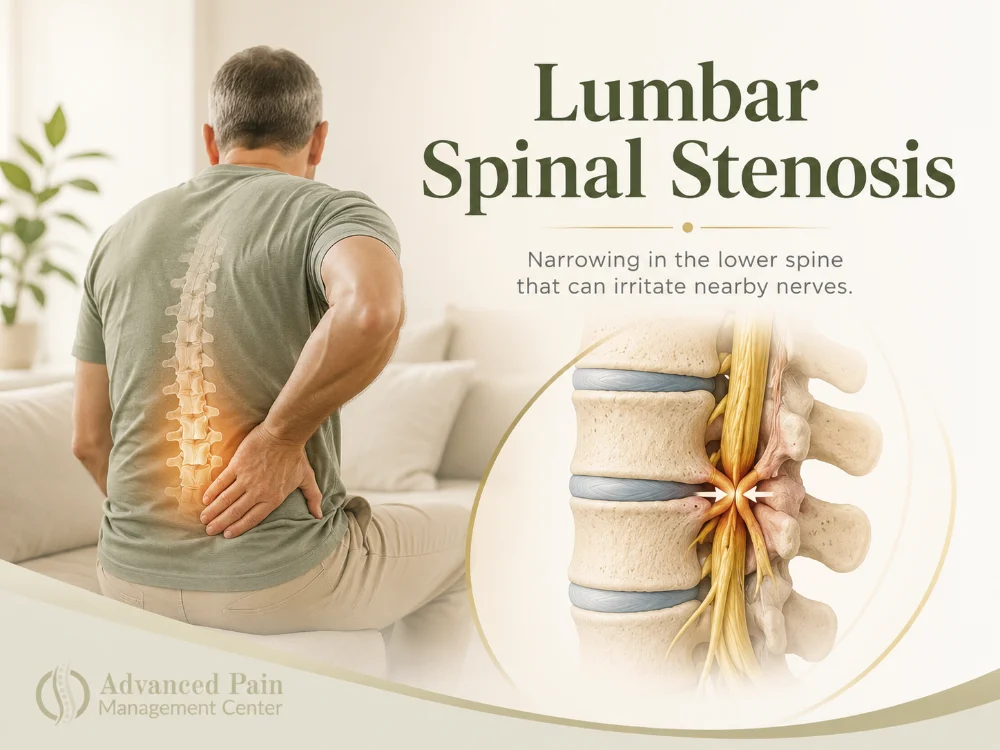
If lower-back trouble now comes with leg pain, heaviness, numbness, or a walking distance that keeps getting shorter, the problem may not be your back alone. It may be the nerves in your lower spine. Advanced Pain Management Center is an interventional pain practice at 10305 SW Park Way, Suite 300, Portland, OR 97225 that evaluates and treats lumbar spinal stenosis in Portland. This page explains what lumbar spinal stenosis is, why it causes leg symptoms and neurogenic claudication, how it is diagnosed, and the range of treatment options, from conservative care and injections to minimally invasive decompression and stabilization for selected patients.
The goal is not to push one procedure. It is to identify where and why nerves are being compressed, then match the least invasive appropriate step to your diagnosis, symptoms, and goals. If you are trying to understand your options before considering major open back surgery, this page is a starting point, and an in-person evaluation is the next one.
Book Your Portland Stenosis Evaluation | Call (503) 295-0730
What Lumbar Spinal Stenosis Is and Why It Causes Leg Symptoms
Lumbar spinal stenosis is narrowing of the spaces in the lower spine, either the central canal or the openings where nerve roots exit. When those spaces narrow, nerves traveling from the lower back into the legs can become irritated or compressed, which helps explain why a lower-back condition may cause significant leg symptoms. The narrowing often develops gradually through age-related changes such as arthritis, disc degeneration, thickened ligaments, or bone spurs, and lumbar spinal stenosis becomes more common in older adults.
Stenosis can occur at different levels and for different reasons, and the lumbar spine is only one part of the picture. For a broader overview of the condition and other types, the practice’s spinal stenosis treatment in Portland page covers stenosis more generally. This page stays focused on lumbar stenosis and the leg, standing, and walking symptoms it tends to cause.
Neurogenic Claudication: Why Symptoms May Worsen With Standing and Improve With Sitting
Lumbar Stenosis and Sciatica: Related, but Not the Same
Common Lumbar Stenosis Symptoms
Symptoms vary from person to person, and some people feel more in the back while others feel more in the legs. Patients evaluated for lumbar stenosis commonly describe:
- Lower-back discomfort, sometimes with buttock, thigh, or calf pain
- Radiating leg pain that may feel like sciatica
- Numbness, tingling, burning, or a heavy feeling in the legs
- Leg weakness or cramping, especially with activity
- Symptoms that build with standing or walking and ease with sitting or leaning forward
- Reduced walking tolerance or trouble standing for long periods
How Lumbar Spinal Stenosis Is Diagnosed in Portland
Treatment should not be chosen from an image alone. Many people have narrowing visible on an MRI without matching symptoms, so imaging is only one part of the picture. A careful evaluation at the practice generally considers your symptoms and how they behave, functional limitations such as how far you can walk, a physical and neurological examination, and MRI or other imaging when appropriate. It also considers where the nerve is being compressed, which structures are involved, whether spinal instability is present, what treatments you have already tried, how you responded, and your overall health.
The purpose of that process is to connect your symptoms to a specific, treatable source rather than to assume that any narrowing on a scan needs a procedure. It is also what makes it possible to match a treatment to your particular situation instead of applying the same step to everyone.
These reviews describe individual patient experiences. Treatment recommendations, recovery, and results vary.
“Dr Fiks and Bridget have been wonderful and caring to my issues. They take the time to listen and we work together to find solutions to my issues. The medical assistants and front desk are amazing as well.”
Lumbar Spinal Stenosis Treatment Options at the Portland Office
Conservative Care and Outside Therapy Referrals
Epidural Steroid Injections for Radiating, Nerve-Related Leg Pain
When radiating leg pain is associated with irritation of a lumbar nerve root, an epidural steroid injection may be considered as part of symptom management. The expected benefit depends on what is causing the symptoms. Current evidence suggests epidural steroid injections can provide modest short-term benefit for some people with lumbar radiculopathy, while evidence for lumbar spinal stenosis itself is more limited. An epidural steroid injection may reduce inflammation around an irritated nerve, but it does not physically widen a narrowed spinal canal and is not a decompression procedure. Whether an injection is appropriate depends on the diagnosis, symptoms, imaging, and previous treatment response.
Minimally Invasive Lumbar Decompression
When narrowing is structurally compressing the nerves, the aim of minimally invasive spinal decompression is to make more space around them. The practice focuses on direct, minimally invasive and endoscopic lumbar decompression rather than stand-alone indirect spacer treatment. Depending on the anatomy, options the practice performs may include the mild procedure as a minimally invasive decompression for appropriately selected patients, interlaminar decompression, and endoscopic less invasive decompression, known as ELID, including ELID EX for narrowing around an exiting nerve root and ELID DX when disc material is contributing to nerve compression. These are candidacy-based procedures. They are not right for every patient or every anatomical cause of stenosis, and results, recovery, and durability of benefit vary. Vladimir Fiks, MD, performs the practice’s spinal decompression procedures.
Decompression With Stabilization for Selected Instability
Sometimes evaluation and imaging suggest that spinal instability is contributing to symptoms. In selected cases, decompression may be combined with stabilization, using approaches such as interspinous distraction and fusion, facet fusion, or minimally invasive lumbar fusion when appropriate. Interspinous devices such as StabiLink and InSpan may be used for selected interspinous fixation and fusion cases. Stabilization is a selected-case decision, not a routine part of treating lumbar stenosis, and it is considered only when the clinical picture and imaging indicate that instability is part of the problem.
Spinal Cord Stimulation for Persistent Nerve Pain
For a smaller group of selected patients with persistent neuropathic pain that has not responded adequately to more definitive treatment, or when other options are not suitable, spinal cord stimulation may be discussed. It is important to distinguish it from decompression. Spinal cord stimulation is aimed at managing pain signaling. It does not physically decompress a narrowed lumbar canal. For a small number of highly selected patients with refractory pain, other advanced pain-management options may also be discussed on an individual basis.
Procedure Setting, Sedation, Recovery, and Coverage
Risks and When to Seek Urgent Care
Every procedure carries some risk, and the risks differ by procedure and patient. Depending on the treatment, these can include infection, bleeding, lack of benefit, and neurological injury. Risks, benefits, limitations, alternatives, and expected recovery are reviewed before a procedure so patients can make an informed decision about their care.
Seek emergency medical care for new loss of bladder or bowel control, new difficulty urinating or urinary retention, numbness around the groin, genitals, buttocks, or inner thighs (sometimes called saddle numbness), or rapidly worsening leg weakness or difficulty walking. These symptoms can occur with severe nerve compression, including cauda equina syndrome, and should not wait for a routine pain-management appointment.
Why Consider Advanced Pain Management Center for Lumbar Stenosis Care in Portland?
Several features of Advanced Pain Management Center’s lumbar stenosis care may be relevant when considering an evaluation in Portland. The points below reflect the practice’s current services, provider roles, and treatment approach.
- A diagnosis-first approach: the team works to identify where and why nerves are compressed before recommending a procedure, rather than treating an image.
- Physician-performed decompression: Vladimir Fiks, MD, performs the practice’s spinal decompression procedures, supported by experienced providers and clinical staff.
- A least-invasive-appropriate philosophy: care is organized to start with conservative and injection-based options and to consider decompression or stabilization when the diagnosis supports it.
- Direct and endoscopic decompression options: the practice focuses on minimally invasive and endoscopic lumbar decompression for appropriately selected patients.
- An option to consider before major open surgery: for selected patients, minimally invasive treatment may be an option to explore before larger open spinal surgery, though it is not right for everyone.
- Coordinated, whole-person care: physical therapy, rehabilitation, or behavioral support may be coordinated or referred to other providers when clinically appropriate and incorporated into the overall treatment plan.
- Serving Portland since 2000: the practice has focused on interventional pain diagnosis and treatment for the Portland area for more than two decades.
- Multilingual care: the team includes providers who speak English, Spanish, and Russian.
“Very kind, professional, engaging. The staff are very helpful, ready to inform you on any concerns you may have. It is an office staffed by people who appear to really enjoy their work.”
The Portland Providers Who Diagnose and Treat Lumbar Stenosis
Every lumbar stenosis plan at the practice is guided by its licensed providers, who evaluate symptoms, review imaging, and match treatment to the diagnosis.
Vladimir Fiks, MD | Interventional Pain Management Physician
Vladimir Fiks, MD, is the interventional pain physician who leads spine and back pain care at the practice and performs its spinal decompression procedures. He is a Regenexx physician focused on interventional and image-guided care. Dr. Fiks graduated from Saratov University in Saratov, Russia, completed an internship at Jefferson Frankford Hospital in Philadelphia, and completed both a residency in anesthesiology and a fellowship in pain management at Oregon Health & Science University in Portland. He practices both medical and interventional pain therapies and speaks Spanish, English, and Russian.
“Dr. Fiks is most knowledgeable about all areas of pain management. He is concerned about providing the best care for his patients using state of the art procedures. His staff is caring and available to assist in your treatment and in answering your questions. They are compassionate and attentive.”
Dmitriy Shore, PA-C | Interventional Pain Medicine Provider
Dmitriy Shore, PA-C, is nationally board certified by the National Commission on Certification of Physician Assistants and has devoted his career to the treatment of chronic pain, with a focus on compassionate, patient-focused care. He helps identify appropriate decompression candidates, assists with evaluation and treatment planning, and supports postoperative care alongside Dr. Fiks and the clinical team.
Alberto Rodriguez, PA-C, MS | Interventional Pain Medicine Provider
Alberto Rodriguez, PA-C, MS, earned a Master of Science degree and completed his Physician Assistant studies at Pacific University, and has provided patient-centered care across orthopedics, urgent care, family medicine, and pain management. He believes care begins with listening, and he helps evaluate patients, identify appropriate candidates, participate in treatment planning, and support postoperative care.
Quick Answers for Portland Patients Considering Lumbar Stenosis Care
Is Advanced Pain Management Center actually located in Portland?
Yes. The office is at 10305 SW Park Way, Suite 300, in the West Haven area of Southwest Portland, near the US-26 corridor and Providence St. Vincent Medical Center.
Who performs the decompression procedures?
Vladimir Fiks, MD, performs the practice’s spinal decompression procedures, supported by the practice’s physician assistants and clinical staff who assist with evaluation and postoperative care.
Will I be put under general anesthesia for a decompression procedure?
The practice’s decompression procedures are generally performed as outpatient procedures using local anesthesia and IV sedation rather than general anesthesia, with discharge after a period of monitoring. Details are confirmed during your evaluation.
Areas We Serve for Lumbar Spinal Stenosis Care in Portland
Advanced Pain Management Center provides lumbar spinal stenosis evaluation and treatment from its office at 10305 SW Park Way, Suite 300 in Portland. The practice serves Portland and nearby communities in Oregon and Southwest Washington, including:
- Portland, OR 97225, including the West Haven and Cedar Mill areas
- Downtown Portland and the surrounding close-in neighborhoods
- Northwest Portland and the Pearl District
- Goose Hollow, Hillsdale, and Multnomah Village
- Raleigh Hills and the Sylvan and US-26 corridor
- Southwest Portland near Providence St. Vincent Medical Center
- Beaverton, Tigard, Hillsboro, and Lake Oswego
- The greater Portland area and Southwest Washington
How Lumbar Stenosis Care Fits Into a Portland Week
Portland activities can make reduced standing or walking tolerance more noticeable. Walking through Washington Park or along the paved paths at the International Rose Test Garden, or spending time at Washington Square, can involve periods of standing and walking. If these activities bring on leg pain, heaviness, numbness, tingling, or cramping that improves with sitting or leaning forward, that pattern can occur with neurogenic claudication, but it does not confirm lumbar spinal stenosis by itself. Advanced Pain Management Center’s SW Park Way office is located near Providence St. Vincent Medical Center and the US-26 corridor, providing a recognizable west-side Portland reference point for the practice.
Set Up a Lumbar Stenosis Evaluation in Portland
Call (503) 295-0730 or schedule online to start a consultation conversation with the Advanced Pain Management Center team. An evaluation focuses on identifying the source and location of nerve compression and whether conservative, injection-based, decompressive, or stabilization treatment may be appropriate for your individual case.
- Address: 10305 SW Park Way, Suite 300, Portland, OR 97225
- Phone: (503) 295-0730
- Website: https://apmconline.org/
- Hours: Monday to Friday: 8:00 AM to 5:00 PM. Saturday: Closed. Sunday: Closed.
Call (503) 295-0730 | Book Your Portland Stenosis Evaluation
Advanced Pain Management Center 10305 SW Park Way, Suite 300, Portland, OR 97225
Frequently Asked Questions About Lumbar Spinal Stenosis Treatment in Portland, OR
What is the best treatment for lumbar spinal stenosis?
There is no single best treatment for everyone. The right option depends on your symptoms, imaging, and evaluation, and care usually starts with the least invasive appropriate step, from conservative care and injections to minimally invasive decompression or stabilization when the diagnosis supports it.
Can lumbar spinal stenosis be treated without surgery?
Many patients begin with nonsurgical care, which may include activity modification, medications when appropriate, outside therapy referrals, and selected injections. Some people manage their symptoms without decompression, while others with persistent symptoms and structural nerve compression may be candidates for minimally invasive or more extensive surgical treatment. Whether a procedure is needed depends on symptoms, neurological findings, imaging, response to previous care, anatomy, and overall health.
What are the symptoms of lumbar spinal stenosis?
Common symptoms include lower-back discomfort, buttock, thigh, or calf pain, radiating leg pain, numbness, tingling, heaviness, cramping, leg weakness, and reduced walking or standing tolerance, often eased by sitting or leaning forward.
Can lumbar spinal stenosis cause sciatica?
Lumbar stenosis can compress or irritate lumbar nerve roots and may produce radiating leg pain that many people describe as sciatica. Sciatica is a description of that radiating pain and can have other causes, so an evaluation looks at where the nerve is being compressed.
What is the difference between lumbar spinal stenosis and sciatica?
Lumbar spinal stenosis is narrowing in the lower spine that can compress nerves. Sciatica describes radiating leg pain along the sciatic nerve. Stenosis is one possible cause of sciatica-like pain, but the two are not the same, and sciatica can come from other sources.
Why does spinal stenosis hurt when I walk but feel better when I sit?
In lumbar spinal stenosis, standing and walking upright can reduce the available space around affected nerves and may bring on leg symptoms. Sitting or leaning forward can increase the available space and ease symptoms for some people. This posture-related pattern is commonly associated with neurogenic claudication, although symptoms alone do not establish the diagnosis.
What is neurogenic claudication?
Neurogenic claudication is leg pain, heaviness, cramping, or numbness that builds with standing or walking and improves with sitting or bending forward. It is a hallmark pattern of lumbar spinal stenosis and reflects reduced space around the nerves.
Do epidural steroid injections help lumbar spinal stenosis?
Epidural steroid injections may be considered when nerve irritation or radiating leg symptoms are part of the clinical picture, but their benefit varies. Current evidence suggests they may modestly reduce disability for some people with lumbar spinal stenosis, while short-term pain reduction for stenosis itself has not been clearly demonstrated. An epidural injection does not physically widen the spinal canal and is not a decompression procedure.
When is spinal decompression considered for lumbar spinal stenosis?
Minimally invasive decompression may be considered when evaluation and imaging show that narrowing is structurally compressing the nerves and symptoms have not responded adequately to more conservative care. Candidacy depends on the anatomy and the individual.
How is lumbar spinal stenosis diagnosed?
Diagnosis combines your symptoms and how they behave, functional limitations, a physical and neurological examination, and MRI or other imaging when appropriate. Treatment is not chosen from imaging alone, since narrowing can appear on a scan without matching symptoms.
How long is recovery after minimally invasive lumbar spinal decompression?
Recovery varies by procedure and patient. Many procedures are outpatient, some short-term postoperative discomfort is common, and medication may be used for several days when appropriate. Your provider gives individualized instructions rather than a single fixed timeline.
What minimally invasive treatments are available for lumbar spinal stenosis in Portland?
Depending on the anatomy, options at the practice may include the mild procedure, interlaminar decompression, and endoscopic less invasive decompression, known as ELID, with stabilization added only for selected patients when instability is present.
Who evaluates lumbar spinal stenosis in Portland if I want to discuss minimally invasive options?
Advanced Pain Management Center is an interventional pain practice in Portland where Vladimir Fiks, MD, evaluates lumbar spinal stenosis and performs minimally invasive decompression for appropriately selected patients. Whether a minimally invasive approach is suitable depends on symptoms, neurological findings, imaging, anatomy, previous treatment, and overall health.
Does APMC offer minimally invasive lumbar decompression in Portland?
Yes, for appropriately selected patients. The practice focuses on direct and endoscopic minimally invasive lumbar decompression, and candidacy is determined by an evaluation of your symptoms, imaging, and overall health.
What should I bring to a lumbar spinal stenosis evaluation in Portland?
It helps to bring any prior imaging such as an MRI report, a list of treatments you have already tried and how you responded, your current medications, and a description of what worsens or eases your symptoms.
Lumbar Spinal Stenosis Health Resources From Advanced Pain Management Center
To learn more about lumbar spinal stenosis and how it can be evaluated and treated, these Advanced Pain Management Center resources expand on topics covered above.
Lumbar stenosis education
- Minimally Invasive Lumbar Stenosis Treatment Options: a closer look at minimally invasive options and how treatment decisions are made.
- Spinal Stenosis Procedures That May Help Relieve Nerve Compression: an overview of procedures aimed at relieving pressure on compressed nerves.
- Spinal Stenosis Treatment with Spinal Decompression: more detail on decompression and how it may differ by the source of narrowing.
- Chronic Sciatica in Portland: When Is Interventional Treatment the Right Option?: helpful when leg pain feels like sciatica and you want to understand the difference.
- Is the StabiLink Device the Right Choice for Your Spinal Fusion?: useful if stabilization or interspinous fusion has been discussed for instability.
Related APMC treatment pages
- Spinal Stenosis Treatment in Portland, OR: the broader spinal stenosis overview for other types and general information.
- Spinal Decompression: the practice’s decompression service page.
- Spinal Injections: including epidural steroid injections for nerve-related symptoms.
- Minimally Invasive Spinal Fusion: stabilization options for selected patients with instability.
- Spinal Cord Stimulation: for selected patients with persistent nerve pain.
Meet the physician
- Vladimir Fiks, MD, Interventional Pain Management Physician: the physician who performs the practice’s spinal decompression procedures.
Lumbar Stenosis Care in Portland That Starts With a Focused Evaluation
If leg pain, heaviness, numbness, or reduced walking tolerance is shaping your days, Advanced Pain Management Center can evaluate what may be contributing and help you understand your options. The team connects symptoms, examination findings, and imaging when appropriate, then explains what conservative care, injections, decompression, and selected stabilization procedures can and cannot reasonably address based on your diagnosis and goals.
Take the First Step Toward Understanding Your Leg and Back Symptoms
Book Your Portland Stenosis Evaluation | Call (503) 295-0730
Advanced Pain Management Center 10305 SW Park Way, Suite 300, Portland, OR 97225
Hours:
- Monday to Friday: 8:00 AM to 5:00 PM
- Saturday: Closed
- Sunday: Closed